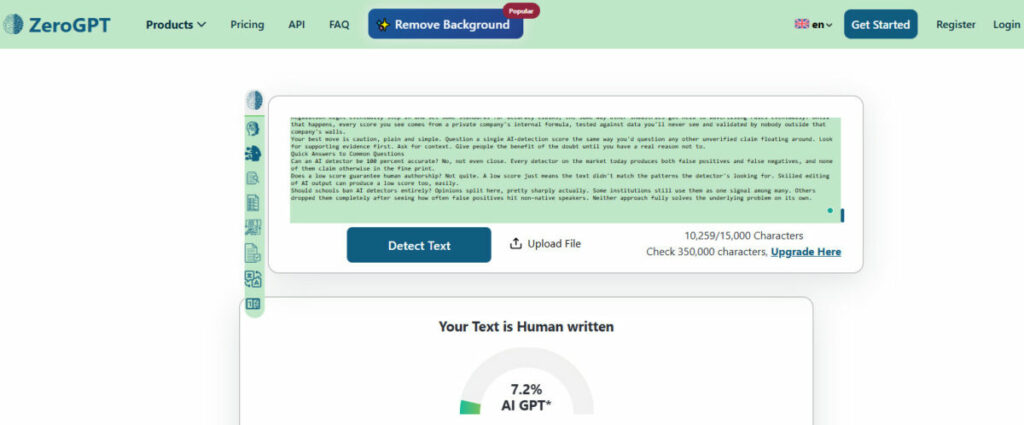
You’ve seen the warning before, right? A teacher flags an essay. A client questions a blog post. An editor rejects a submission out of nowhere. Reason’s always the same: an AI detector said so. But what is this thing, actually? And how much should you trust it? Honestly? Not as much as people think. What an AI Detector Actually Does An AI detector is software that scans text and takes a guess — human or machine? Schools use it to catch cheating. Publishers screen submissions with it. Companies run it before content goes live. Recruiters even use it on cover letters now, which feels like a stretch, but here we are. Simple idea. Messy execution. The Two Signals It Measures Most detectors lean on patterns, not proof. Worth remembering that one. AI models tend to write with a rhythm you can almost predict. Word choices follow the usual paths. Sentence length stays even, sometimes too even. Human writing wanders more. You repeat a word you shouldn’t. You break a grammar rule on purpose, just because it feels right in the moment. You throw in a weird metaphor because your brain went there that day, and nobody’s stopping you. Detectors measure two things mainly: perplexity and burstiness. Perplexity tracks how predictable each word is, given what came before it. Low perplexity, the text follows expected patterns closely. High perplexity, it takes turns a model probably wouldn’t take. Burstiness looks at variation across a whole passage. Short sentence. Then a long one. Then a fragment, maybe, just to break things up. Human writing has more of that, usually a lot more. The Tools You’ll Actually Run Into A handful of names dominate here. Turnitin sits inside most university systems and checks student work on autopilot. GPTZero built its whole reputation around AI detection and stays popular with teachers especially. Originality.ai targets publishers and agencies who need to vet freelance work at scale, fast. Copyleaks and Winston AI round things out, each running a slightly different scoring method under the hood. None of them agree with each other, not consistently anyway. Feed the same paragraph into all five, you’ll probably get five different numbers back. That inconsistency alone tells you something about how young this technology really is. Why the Scores Get It Wrong Here’s the thing. A score is a guess, not a fact. No detector reads your mind, checks your keystrokes, or watches you type. It only measures patterns. And patterns mislead people, sometimes in ways that genuinely hurt. False Flags on Non-Native Writers Take a non-native English speaker. Their sentences often land simpler, more consistent in structure. Not because a machine wrote them — because that’s how a second language gets handled when you’re being extra careful. That style just happens to overlap with AI output, pure coincidence. Several universities faced real backlash after their detectors flagged international students at far higher rates than native speakers. The tool didn’t catch cheating there. It caught an accent, basically, just sitting on the page instead of in someone’s voice. False Flags on Clean Human Writing Now flip it. A skilled writer edits with a clear head, tightens every line, cuts the fluff ruthlessly. Clean grammar and tight structure can trigger a high AI score too, weirdly enough. Good writing and machine writing sometimes look alike on the surface, even when the source couldn’t be more different underneath the hood. Easy Evasion Once Text Gets Edited Detectors also fall apart once AI text gets edited even a little. Someone takes a machine draft, rewrites a handful of lines, swaps a few words around. Done — score tanks, often completely. The tool measures surface patterns, not intent or origin, so a determined user slips right past it with barely any effort. A Real Example Worth Knowing Stanford researchers tested several popular detectors against essays from non-native English speakers back in 2023. The false positive rate for that group topped 50 percent on some tools, compared to almost zero for native speakers writing on the exact same topics. Not a small gap. A full-blown fairness problem, honestly, and it pushed several schools to pause automatic AI-detection policies altogether. Why Accuracy Keeps Slipping Over Time AI models keep improving, and fast — faster than most people realize, probably. Each new version writes more like a person than the last one managed. GPT-4, Claude, Gemini, all of them produce text with more natural variation than older models ever pulled off. Detectors trained on last year’s AI output fall behind quickly. Sometimes within months, not years. Language itself keeps shifting too, and not always in obvious ways. As more AI text spreads across the internet, human writers start picking up some of its habits without even clocking it. Emails, essays, reports — they all drift toward sounding a bit more uniform across the board, machine-written or not. What the Tests Sh
Don't miss out on breaking stories and in-depth articles.