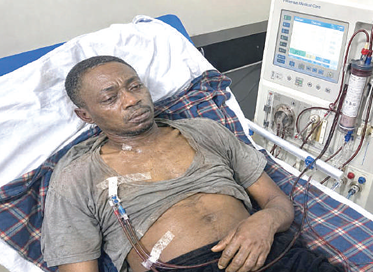
…Most patients arrive when kidneys have failed — NMADU…OYEWALE: Painkillers, herbal mixtures silently destroy organs…Water contains harmful heavy metals — YEMITAN…ODUBANJO: Education, early screening remain best defense By Chioma Obinna Three mornings every week, Uche Oke left home before dawn, clutching a small bag that had become as familiar to him as his own shadow. Inside were a bottle of water, a few personal belongings and the hope that another four-hour dialysis session would buy him a little more time. At just 32, a trader and father of one should have been expanding his business and raising his young family. Instead, his life had become a cycle of hospital appointments, mounting medical bills and desperate prayers for a kidney transplant that remained painfully out of reach. A few years earlier, headaches were nothing unusual. Like millions of Nigerians, he simply bought painkillers from the neighbourhood pharmacy. Fever meant swallowing herbal mixtures recommended by friends with drinking water from the family’s borehole. Routine medical check-ups never crossed his mind because he believed he was healthy. Then came persistent stomach pain. Doctors initially treated him for Helicobacter pylori ulcer. But instead of improving, his condition deteriorated dramatically. He became unusually weak. His legs swelled. Painful mouth sores made eating difficult. He vomited repeatedly, lost weight and eventually stopped passing urine. Alarmed, his family rushed him to hospital, where doctors delivered devastating news, both kidneys had failed. The diagnosis changed everything. Doctors said he required an urgent kidney transplant. The procedure would cost about ¦ 18 million, while securing a compatible donor would require another ¦ 25 million, an impossible amount for his family. Dialysis becomes lifelineThree times every week, Uche spent hours connected to a dialysis machine while his family appealed for financial assistance. But the money never came. He died waiting. His death left behind a grieving wife, a young child, and a question that echoes in hospitals across Nigeria, how many more lives will be lost before kidney disease receives the attention it deserves?Sadly, nephrologists say Uche’s story is no longer unusual. Across Nigeria, dialysis centres are receiving increasing numbers of patients whose kidneys have already suffered irreversible damage before they ever see a specialist. Many are young adults in the prime of their lives. Others are breadwinners whose illness plunges entire families into poverty. Behind the rising burden lies a dangerous mix of undiagnosed hypertension and diabetes, indiscriminate use of painkillers, widespread reliance on unregulated herbal remedies, environmental toxins, poor health-seeking behaviour and a healthcare system that many patients simply cannot afford. Silent epidemic Unlike infectious disease outbreaks that trigger emergency responses, chronic kidney disease progresses quietly. The kidneys can lose much of their function without causing obvious symptoms, allowing damage to accumulate silently over several years. Consultant Nephrologist at the Federal Medical Centre (FMC), Ebute Metta, Dr. Danladi Nmadu, says that is precisely why so many Nigerians arrive at hospital when very little can still be done. “The kidneys are very resilient organs. You can remove one kidney completely and a person can still live normally”, Mmadu said. “Even when kidney function has dropped significantly, many people still feel well. “By the time symptoms become obvious, the kidneys have often almost completely shut down. “The result is devastating. Patients who could have been treated early instead require lifelong dialysis or kidney transplantation. What worries specialists even more is, who is becoming ill? “In developed countries, kidney disease usually affects older people in their sixties and above.“But here in Nigeria, many of the patients requiring dialysis are between 40 and 60 years old, and we are increasingly seeing younger adults. “These are people in their most productive years, the people raising families, running businesses and contributing to the economy.” Consequences far beyond hospital When a family’s breadwinner develops kidney failure, incomes disappear almost overnight while medical expenses multiply. Savings vanish. Businesses collapse. Children leave school. Entire households become trapped in poverty. Growing burden hiding in plain sight Although chronic kidney disease has long existed in Nigeria, health experts say it is becoming an increasingly important public health challenge. Available studies estimate that millions of Nigerians are living with varying degrees of kidney disease, many without knowing it. One reason is that kidney disease rar
Don't miss out on breaking stories and in-depth articles.