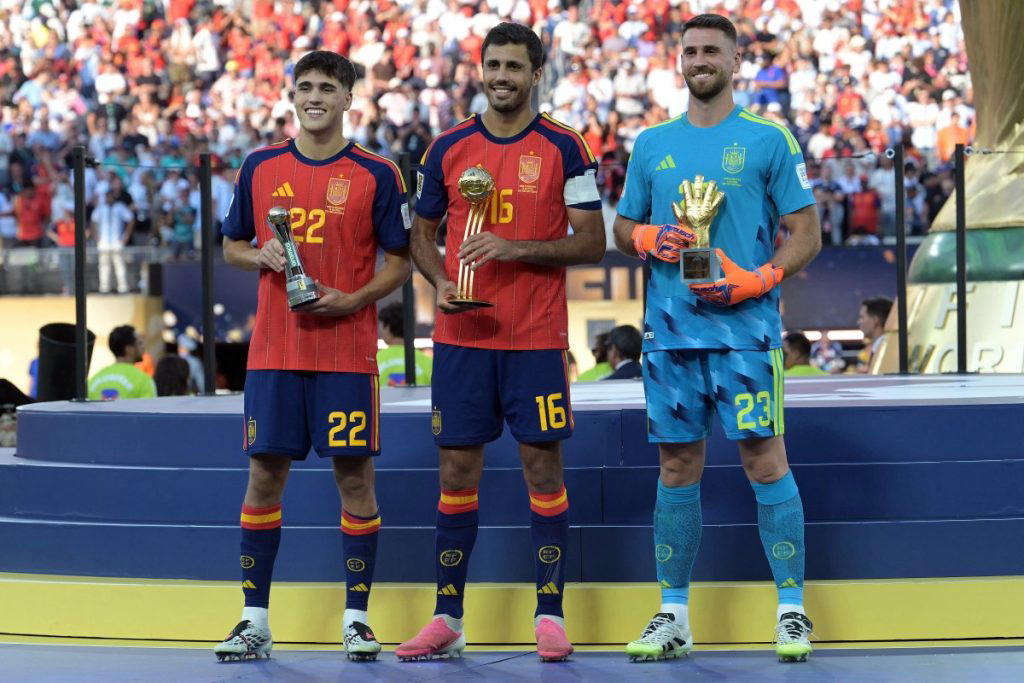
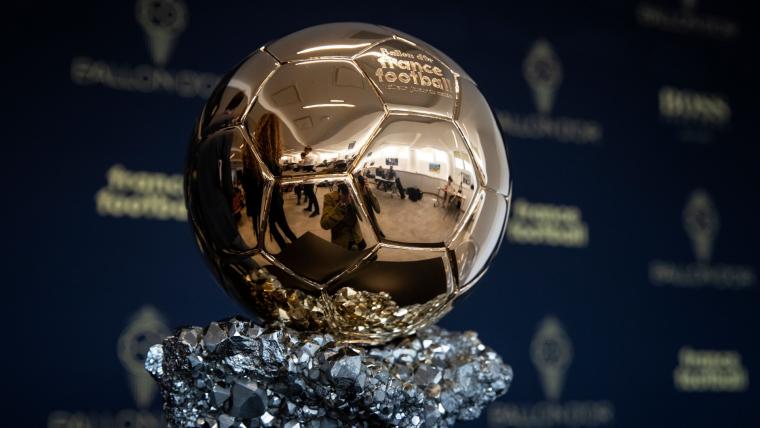
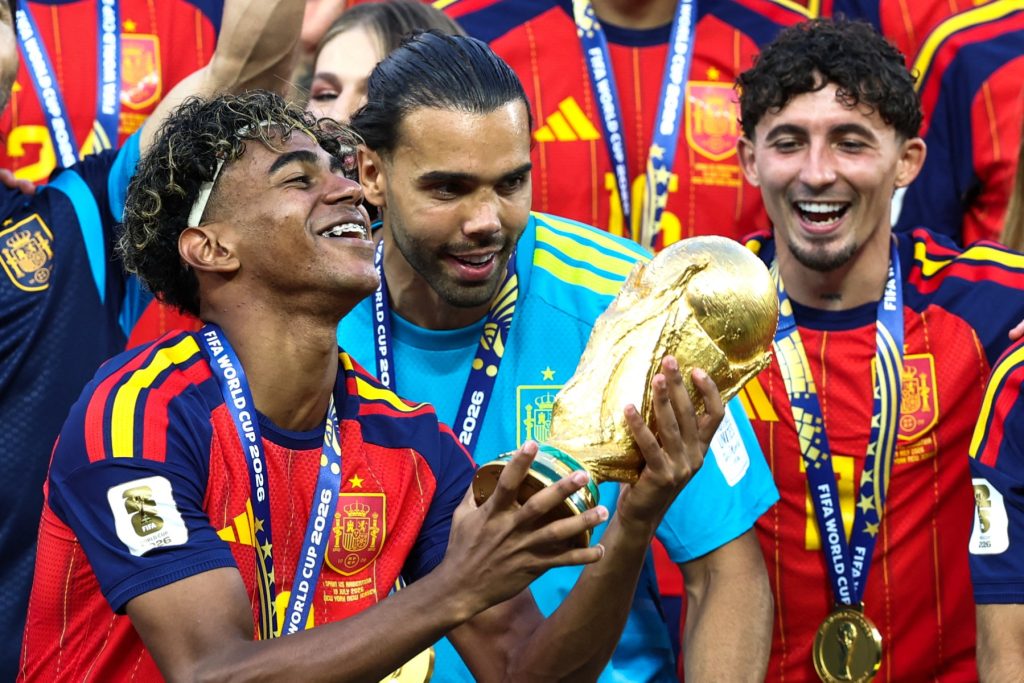
REUBEN ABATI The straight-forward, honest and correct answer to the question raised above is: Yes. Spain won at the end of the day on Sunday, July 19, 1- 0 against Argentina, defending champions since Qatar 2022, and that was the climax of a tournament that lasted for 39 days during which 104 matches were played , by 48 teams from six Federations, participating (for the first time in the World Cup finals), in three countries – Canada, Mexico and the United States in 16 host cities -11 in the United States (Atlanta, Boston Dalla, Houston, Kansas City, Los An-geles, Miami, New York City/New Jersey, Philadelphia, San Francisco Bay Area and Seat-tle; 3 cities in Mexico – Guadalajara, Mexico City and Monterrey, and two cities in Canada – Toronto and Vancouver. This was the longest, most expansive, indeed the most expensive tournament ever in the history of the World Cup with tickets selling as high as $2,000 and over $10, 000 on the day of the final match. Spain’s victory was very well deserved. Supporters of Argentina and particularly the team’s talisman, Lionel Messi, had hoped that Argentina would win the World Cup back-to-back, but that did not happen. Argentina actually failed to get one shot on target. Instead, Spain dominated the game from start to finish, with 20 shots and 12 on target until Ferrand Torres scored the winning goal in the 106th minute. The tally could even have been higher were it not for Argentine goalkeeper, Emiliano Mar-tinez, who was busy throughout until he got a shot that made the difference from Torres. It was a sad goal, but it was also perfectly made. It was a historic moment. Spain is the first na-tion ever to hold both the men’s and women’s FIFA World Cup titles at the same time. It is al-so the first country to be the reigning men’s Champion of the World Championship, the Euro-pean Championship and the Olympics Championship simultaneously. In addition, Spain won the Golden Ball in the final (Rodri), best young player (Pan Cubarsi) and the Best Goalkeeper with Golden Gloves (Unai Simon). The Spanish team conceded only one goal and scored 14 goals throughout the tournament. To be fair, Argentina could have been beaten by more than one goal. The best team won. Spain played throughout as a complete team, with possession and positional football to win their Second World Cup title. Argentina relied heavily on their goalkeeper, Emiliano Martinez, and Lionel Messi, easily the best player in the world who was reduced to tears at the end of what may well be, at 39, his last World Cup appearance. He will always be remembered as a legend of the tournament with 21 World Cup goals and clearly a first rank artist of the game at club, national and international levels, a genius and a master builder. But despite the hype that heralded the final match, it was not even the most exciting match of the tournament. In that category would be the match between Netherlands and Japan in Group F which ended 2-2, Algeria vs Austria, 3- 3, and Belgium vs Senegal in the Round of 32 at 3- 2. The Teranga Lions of Senegal almost defeated Belgium! Argentina vs Cabo Verde which ended 3-2. Cabo Verde, a country of 529, 000 people, the smallest country at the World Cup, which does not even have a properly organized national team had a fairy tale run, with its 40-year-old goalkeeper, Vozinha, who put up a memorable, remarkable performance. That was a match! Cabo Verdeans nearly disgraced Argentina. In the Round of 16, Norway knocked out Brazil 2-1 to get to the quarter finals for the first time. Almighty Brazil was thrown out. Eng-land defeated Mexico in the Round of 16, but the same England was so disappointing in the semi-final match against Argentina playing a needless defensive game after going ahead with a goal in the first half. They would later redeem their brand in the third-place play-off in which they defeated France. This was England’s best outing at the World Cup since 1966 when they won the trophy, and now a bronze medal that was considered not good enough, even if they won 6 -4 against one of the best teams in the world in the 2026 tournament. There was also Argentina against Egypt, which Messi’s team won 3-2 in the Round of 16. Egypt felt cheated, so heartbroken, and had to complain about the officiating. On the whole, the World Cup 2026, in its expanded format projected the beautiful game so well, there is even now a lobby for fur-ther expansion to 64 teams in future editions. The continent of Africa got a record 10 slots, nine of the teams reached the knock-out stage, and African countries were no spectators as they gave a good account with the competent per-formances by Morocco and Egypt, which both made it to the Quarter finals, and the Round of 16, before being eliminated by France and Argentina respectively. DR Congo, appearing in the World Cup finals for a second time since 1974, drew against Portugal 1-1, defeated Uzbek-istan, 3 -1
Don't miss out on breaking stories and in-depth articles.