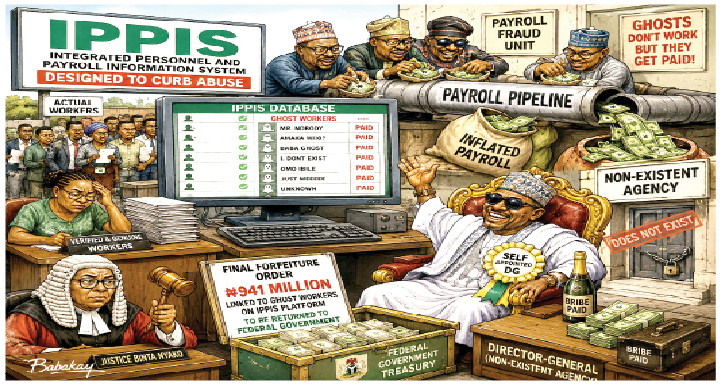
Why do ideas that work seamlessly in other countries often fail in Nigeria? Why do many well-conceived government initiatives struggle to achieve their intended objectives? In more organised societies, traffic lights regulate movement because motorists obey them. Closed Circuit Television (CCTV) cameras installed on roads and in public places serve their purpose. Public utilities function with minimal disruption. The list is endless. Yet in Nigeria, even when successive governments implement reforms that seem sound on paper, they often fall short. Why? The answer is simple: endemic corruption that has infiltrated every level of our lives. That is precisely the story of the Integrated Personnel and Payroll Information System (IPPIS). Introduced in 2007, IPPIS is a centralised database and payroll platform managed by the Office of the Accountant-General of the Federation. It was developed to process salaries, eliminate ghost workers, combat payroll fraud, and enhance transparency across Ministries, Departments and Agencies (MDAs). Simply put, its mission was to eliminate the ghost worker syndrome and halt the outright theft of public funds through inflated payrolls. The menace persists Years after its introduction, however, payroll fraud persists unabated. Recently, Justice Binta Nyako ordered the final forfeiture of N941 million linked to ghost workers on the IPPIS platform, directing that the money be returned to the Federal Government. Imagine that: funds were consistently paid to non-existent workers through a platform specifically designed to eliminate ghost workers and prevent revenue leakages. Justice Nyako’s ruling comes at a time when Nigerians, both at home and abroad, are still trying to comprehend another bizarre development. A man reportedly woke up one morning, appointed himself, or was allegedly appointed after paying millions of naira in bribes, as Director-General of an agency the federal government later declared non-existent. If anything, this reinforces the popular belief that in Nigeria, almost anything is possible. Just when you think you have seen it all, reality reminds you otherwise. We had a Director-General heading an agency that had no legal backing. Yet, he occupied office space at the Federal Secretariat, within the same complex housing the Office of the Head of the Civil Service of the Federation. He reportedly secured approval to recruit about 300 staff and even organised an investment summit attended by senior security officials and members of the diplomatic community. More astonishingly, the so-called non-existent agency had a budget allocation. And you still think your brain can understand Nigeria? As the nation waits for the legal fireworks expected to unfold when the alleged fake DG finally has his day in court, Justice Nyako’s order forfeiting nearly N1 billion linked to ghost workers raises questions about whether Nigeria itself is merely a scene from an unbelievable film. How long had these fraudulent payments been going on? Who were the beneficiaries? Who facilitated them? When will those responsible be brought to justice? More importantly, can anyone confidently say similar schemes are not operating across other federal and state institutions today? These are questions begging for answers. Nyako’s ruling Justice Nyako granted the forfeiture order while delivering judgment on an application filed by the Independent Corrupt Practices and Other Related Offences Commission (ICPC), which traced and seized the funds during its investigation into the IPPIS fraud in 2024. Earlier, the Commission revealed that its review of the payroll platform uncovered “large-scale payroll fraud involving hundreds of non-existent public servants, with a total sum of N941,994,079.86 traced to accounts linked to the scheme.” According to the ICPC, the fraud was embedded in the payroll systems of several MDAs, where about 587 ghost workers were allegedly inserted into the IPPIS platform by unscrupulous individuals who continued to steal directly from government coffers. The ICPC’s findings further revealed that the payroll fraud occurred in the Ministry of Defence, the Nigeria Police Force, the National Board for Arabic and Islamic Studies, the University of Benin, the University of Calabar, the University of Nigeria, Nsukka, the University of Maiduguri, Ahmadu Bello University, Zaria, and even the Office of the Accountant-General of the Federation. When institutions such as the Ministry of Defence and the Nigeria Police Force appear among agencies where fictitious names were allegedly inserted to siphon public funds, one begins to understand why insecurity remains so difficult to overcome. Those who manipulate payroll systems cannot be trusted to manage resources meant to protect lives and property. They cannot be trusted to deploy intelligence effectively or provide the leadership needed to tackle the country’s security challenges. Perhaps the most un
Don't miss out on breaking stories and in-depth articles.