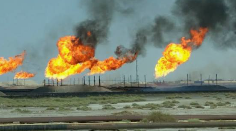
By Folarin Kehinde For decades, Nigeria has remained one of Africa’s largest producers of crude oil and natural gas. Yet, across oilfields in the Niger Delta, billions of cubic feet of valuable natural gas are either burned through routine flaring or lost through leaks and venting, depriving the country of electricity, cooking gas, industrial growth, government revenue and cleaner air. The economic consequences are enormous. Analysis of data from the National Oil Spill Detection and Response Agency (NOSDRA) Gas Flare Tracker shows that Nigeria lost an estimated $5.5 billion (about ₦8.7 trillion) worth of natural gas through routine gas flaring between 2021 and 2025. The estimate represents only the direct market value of gas burned, based on satellite flare detection and average gas prices. However, experts say the actual cost is far higher. Mahmoud Ibrahim Mahmoud, a postdoctoral researcher and environmental scientist with NOSDRA, told Vanguard that Nigeria’s wider economic losses from methane waste and associated gas flaring—including lost electricity generation, liquefied petroleum gas (LPG), industrial feedstock, government revenue, environmental damage and unrealised carbon-market opportunities—could range between $18 million and $28 million daily. Under favourable carbon-market conditions, Mahmoud estimated that the country’s unrealised opportunity could exceed $30 million per day, translating to about $7 billion to $12 billion annually. “The true national loss is substantially larger than the commodity value shown on the Gas Flare Tracker because methane that is flared or vented could otherwise generate electricity, supply households with LPG, support fertilizer and petrochemical industries, earn export revenue and generate taxes and royalties,” he said. A resource burned instead of used Nigeria has one of Africa’s largest proven natural gas reserves, estimated at more than 215 trillion cubic feet, yet gas flaring remains a persistent feature of oil production. According to NOSDRA’s 2025 Gas Flare Report, operators flared about 323 billion standard cubic feet (SCF) of gas during the year. The agency estimated that the wasted gas was worth about $1.1 billion (₦1.49 trillion), generated approximately 17.2 million tonnes of carbon dioxide emissions, and could have produced more than 32,300 gigawatt-hours (GWh) of electricity—enough to significantly improve Nigeria’s power supply. Similarly, data from the Nigerian Upstream Petroleum Regulatory Commission (NUPRC) showed that nearly 204 billion standard cubic feet of gas was flared in 2025 despite overall gas utilisation exceeding 92 per cent. The figures highlight one of Nigeria’s biggest energy contradictions: abundant gas reserves existing alongside persistent electricity shortages and rising cooking gas prices. Counting the real economic loss Mahmoud argued that valuing gas only by its market price significantly understates the impact of methane waste. He noted that captured methane could supply gas-fired power plants, reduce dependence on diesel generators, expand domestic LPG production, provide feedstock for fertilizer and petrochemical industries, generate export earnings through LNG, increase government tax and royalty collections, and earn carbon credits under international markets. “As a conservative estimate, Nigeria is likely foregoing between $18 million and $28 million every day. “When carbon markets are considered, the unrealised opportunity could exceed $30 million daily,” he said. He added that the losses affect all segments of society. “The Federal Government loses taxes, royalties, export earnings and foreign exchange. Oil-producing states lose industrial development and employment opportunities. “Host communities bear the environmental degradation, polluted air, damaged farmlands, declining fisheries and health impacts. “Ordinary Nigerians pay through higher electricity costs, expensive cooking gas, poor energy security and slower economic growth. “In practical terms, everyone pays,” Mahmoud said. Communities living beneath the flames For residents of oil-producing communities, methane waste is not merely an environmental statistic but a daily reality affecting their health, livelihoods and future. Chairman of the Council of Chiefs of Lasukugbene Community in Southern Ijaw Local Government Area of Bayelsa State, Chief Zion D. Kientei, said decades of gas flaring and pipeline leaks had fundamentally altered life in the Niger Delta. He said communities that once depended on thriving rivers, fertile farmlands and abund
Don't miss out on breaking stories and in-depth articles.