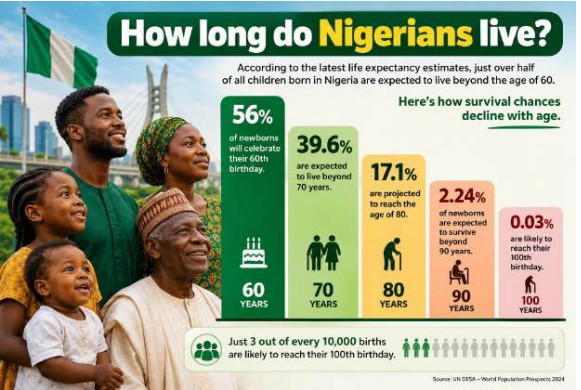
By Sola Ogundipe Ganiat Ojo believed the headache would eventually disappear. The 55-year-old petty trader had lived with the pain for months, brushing it off as the price of long days at the market and the constant struggle to provide for her family. Like many Nigerians, she hardly ever checked her blood pressure. There was always another bill to settle, another customer waiting and yet another reason to put off a trip to the hospital. Then, one afternoon, she collapsed in her shop. Neighbours thought she had simply been overwhelmed by exhaustion, but they rushed her to hospital anyway. Doctors later confirmed she had suffered a massive stroke caused by severe, uncontrolled hypertension. She never regained consciousness and died the following day, leaving behind four children. Stories like hers play out quietly across Nigeria every day. Most never make the headlines. Yet taken together, they expose one of the country’s biggest public health tragedies: millions of Nigerians are dying years, and sometimes decades, earlier than they should. Estimates from the United Nations Population Division and the World Bank put life expectancy at birth in Nigeria at about 54 years, among the lowest anywhere in the world. The global average, by comparison, now exceeds 73 years, according to the World Health Organization (WHO). In countries such as Japan, Switzerland and Singapore, living into one’s 80s or even 90s is no longer exceptional. Health experts say the reasons stretch well beyond medicine. Poverty, weak health systems, poor nutrition, environmental hazards, chronic stress, limited access to healthcare and widening social inequalities all shape how long Nigerians live. Timeline of progress Life expectancy reflects how well a country protects the health and wellbeing of its people from birth through old age. At independence in 1960, a Nigerian could expect to live for about 37 years, according to World Bank estimates. Infectious diseases were widespread, child mortality was extremely high and healthcare services were scarce, especially outside major towns and cities. Today, average life expectancy has risen by almost two decades. Advances in public health mean more children now survive birth and early childhood than in the past. Yet, 57years can not be good enough. Expanded immunisation programmes have cut deaths from vaccine-preventable diseases. Better maternal healthcare has helped more women survive pregnancy and childbirth. Improvements in malaria control, nutrition and sanitation have also played an important role in extending lives. Even so, Nigeria’s progress has lagged behind that of many comparable countries. Although life expectancy has continued to rise, the country remains among those with the shortest lifespans in the world. At the same time, the health burden has shifted. Infectious diseases no longer dominate as they once did. Instead, non-communicable diseases such as hypertension, diabetes, stroke, heart disease, chronic kidney disease and cancer are becoming increasingly common. What is life expectancy? According to the United Nations World Population Prospects 2026, analysed by GeoRank, a Nigerian who reaches the age of 65 can expect to live to about 77.2 years. Someone who reaches 70 is expected to live to around 79.4 years, while a person who turns 75 can expect to live to approximately 82.1 years. For those who celebrate their 80th birthday, average life expectancy increases further to about 85.2 years. These figures do not mean everyone will live to those ages. Instead, they show that once people survive the highest risks of infancy, childhood and middle age, their remaining life expectancy increases significantly. Nigeria’s relatively low life expectancy is driven less by the biology of ageing than by deaths that occur decades before old age. Complications of pregnancy, infectious diseases, uncontrolled hypertension, diabetes, road traffic injuries, violence and other largely preventable causes continue to claim lives far too early. As the WHO points out, life expectancy reflects far more than the performance of hospitals. It is also a measure of how effectively a country protects its people through good nutrition, clean water, education, safe roads, economic opportunity, environmental protection and access to quality healthcare throughout life. Why low life expectancy? Nigeria’s relatively low life expectancy cannot be traced to a single disease or one failure within the health system. It is the cumulative result of many factors acting over a lifetime, beginning with where people are born and the care they receive in childhood, and extending to whether they can afford treatment as adults. A person’s chances of living a long and healthy life are shaped not only by medicine, but also by income, education, nutrition, housing, access to clean water, proper sanitatio
Don't miss out on breaking stories and in-depth articles.