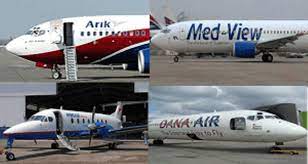
By Dickson Omobola The first half of 2026 was a mixed bag for the country’s air transport sector, with airlines grappling with rising operating costs while government agencies, especially the Federal Airports Authority of Nigeria, FAAN, and Nigeria Civil Aviation Authority, NCAA, came under fresh scrutiny. Read Also: Fake agency originated from Buhari government — Budget Office explains PFIPC allocation While airlines struggled with the sharp increase in the cost of aviation fuel, better known as Jet-A1, and numerous bird strikes, FAAN failed to seamlessly implement its cashless payment policy, which commenced at the Lagos and Abuja airports. In February, fire also gutted the old terminal of the Murtala Muhammed International Airport, MMIA, Lagos, destroying several items, including critical air-to-ground communication equipment. The inferno brought FAAN under scrutiny, with insurance experts claiming that the MMIA and many other FAAN-managed airports across the country lacked insurance cover. The first half of the year also tested the NCAA’s regulatory oversight. One incident that drew public attention to the agency was the landing of a private aircraft on a road in the Ogwashi-Uku area of Asaba, the Delta State capital. Airlines For domestic carriers, the period was particularly challenging. They battled a surge in the price of aviation fuel and numerous bird strikes that disrupted operations and increased maintenance costs. Akwa-Ibom state-owned airline, Ibom Air, said the cost of fueling its aircraft tripled between January and April from an average of N2.1m per flight in January to N7.6m in April. Following a reported 300 per cent spike in the price of Jet-A1 in April, the Airline Operators of Nigeria, AON, threatened to shut down operations from Monday, April 20, 2026. During the period, Air Peace reduced its Abuja-London flight frequency, Rano Air also announced the temporary suspension of some of its flight operations. At the time, AON, in a letter signed by its President, Abdulmunaf Sarina, stated that the price of Jet-A1 sold by marketers had increased from N900 per litre as of February 28, 2026, to N3,300 per litre, forcing some airlines to cut routes, while others temporarily suspended operations. However, the Major Energies Marketers Association of Nigeria, MEMAN, dismissed the claim. MEMAN Executive Secretary, Clement Isong, said the association’s internal market survey showed that the quoted price was more than N1,000 higher than the average rate obtainable in the market. Though he acknowledged the severe pressure on airline operators, Isong attributed the surge in Jet-A1 prices to external shocks, particularly tensions in the Middle East, which disrupted global supply chains and pushed up the cost of refined petroleum products. Also, within the first six months of the year, no fewer than 11 bird strikes were recorded by the country’s airlines, leading to operational disruptions and financial losses. United Nigeria Airlines, UNA, and Nigeria’s largest carrier, Air Peace, were among the airlines worst affected. At one point, UNA suffered three bird strikes within 48 hours, leading to significant operational disruptions. Lamenting the recurring incidents at the 2026 IATA Focus Africa Conference, spokesperson for AON and Chairman of UNA, Professor Obiora Okonkwo, said: “From January to April, we (UNA) have had seven bird strikes. As we speak now, we (UNA) have two aircraft on the ground, AOG. 40 to 50 per cent of the downtime experienced by Nigerian airlines is caused by bird strikes.” FAAN On March 1, FAAN commenced the implementation of its cashless payment policy at the Lagos and Abuja airports. However, the rollout was fraught with challenges and was eventually suspended on the directive of President Bola Tinubu. The policy resulted in long queues and delays for travellers heading to the airports, while other airport users were trapped in hours-long traffic congestion. On the second day of the rollout, Saturday Vanguard observed that, as motorists sought to obtain the FAAN Go Cashless Card and make payments, vehicles queued from the pedestrian bridge at the NAHCO Bus Stop to the Murtala Muhammed International Airport tollgate in Lagos. Commercial and private vehicles attempting to exit the airport were also forced to endure long waits as electronic payment points struggled to process transactions promptly. By the fourth day, although the situation had improved slightly, traffic still stretched from the NIGAV Centre to the airport tollgate. Announcing the suspension after four difficult days, Minister of Aviation and Aerospace Development, Mr Festus Keyamo, said: “Mr President, out of empathy, directed today that we should suspend the present system because it creates a lot of gridlock and Nigerians are suffering as a result of it.” N
Don't miss out on breaking stories and in-depth articles.