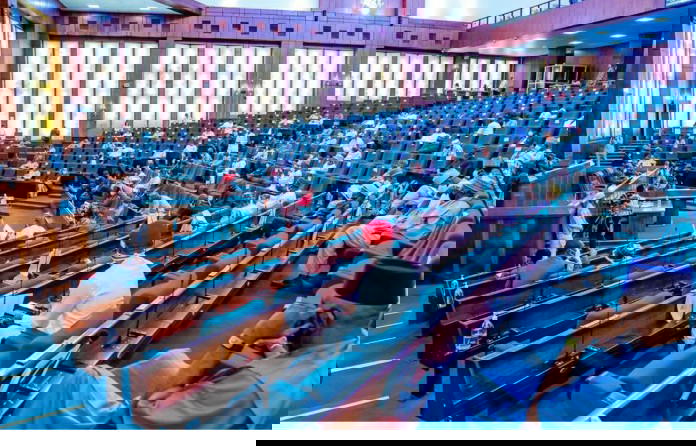
Kasim Sumaina in Abuja The Nigeria Civil Aviation Authority (NCAA) has demanded the restoration of its original 65 percent share of the 5 percent ticket sales charge (TSC) and cargo sales charge (CSC). The Director-General, Civil Aviation, Capt. Chris Ona Najomo, made the call during the Public Hearing of the House of Representatives Aviation Committee’s proposed review of the allocation of the 5% ticket sales charge (TSC) and cargo sales charge (CSC), which was held on Thursday in Abuja. The DGCA averred that the Authority believes that every aviation agency should be adequately funded to effectively discharge its statutory responsibilities. Thus, “if additional financial support is required for NAMA, the Authority submits that such support should first be pursued through the optimisation of its extensive statutory commercial revenue streams, improved operational efficiency and corporate governance, and where necessary, targeted Government support for strategic capital infrastructure, consistent with ICAO policy and international best practice.” “It is on this note that the NCAA respectfully requests that this honourable committee champion the return to the original vision that drove the establishment of the NCAA and NAMA in 1999. We submit that NCAA’s allocation of the 5% TSC be restored to 65% to overcome the deficiencies identified by ICAO at its last audit, and bring Nigeria in line with global best funding practices,” the DGCA called. The Authority further submits that any review of Nigeria’s aviation funding framework should also take cognisance of the fact that the NCAA remains heavily dependent on the Ticket Sales Charge for the discharge of its statutory responsibilities, whereas NAMA already derives the greater proportion of its income from commercial charges levied on aircraft operators for the services it provides. Capt. Najomo explained further that in addition to Federal Government funding, NAMA gets funding for its infrastructure through BASA funds, which, by the way, NCAA does not benefit from. According to him, “NAMA also possesses no less than sixteen (16) commercial revenue streams established by law. These include; over-flight and en-route international charges, domestic en-route charges, charges on Class B message charges, terminal navigation charges, sales of aeronautical information, 6. airspace violation fines, rentage of property, plant and equipment, “Calibration fees, obstacle evaluation fees, telecommunications services, provision of air traffic services at private and state aerodromes, hajj or pilgrimage operations, cartographic survey and cartographic charges, aerial operations charges, consultancy services, as well as the sales, rents or leases of landed properties. These are precisely the types of commercial revenue mechanisms that ICAO envisages for Air Navigation Service Providers,” he noted. The DGCA also said available financial information further indicates that these commercial and operational activities account for approximately 75% of NAMA’s total revenue, while the contentious 5% TSC makes up only about 25%, as against the NCAA’s about 80% reliance on the TSC. The NCAA DG further highlighted that the objective of the proposed review should be achieved in a manner that is consistent with ICAO policy, international best practice, and Nigeria’s obligations as a Contracting State to the Chicago Convention. He reminded that “aviation safety is not sustained by legislation alone. It depends upon competent inspectors, effective surveillance, continuous certification, recurrent technical training, international cooperation and an independent regulator possessing the financial capacity to discharge its statutory mandate without compromise. Every one of these functions depends upon adequate and sustainable funding.” “The proposal before this distinguished Committee should therefore be considered not merely as a redistribution of statutory revenue, but in terms of its potential impact on Nigeria’s ability to sustain an effective State Safety Oversight System consistent with the Standards and Recommended Practices of ICAO and to safeguard the travelling public” he noted. Going down memory lane, he explained that the “Ticket Sales Charge (TSC) and Cargo Sales Charge (CSC) funding mechanism was established, consistent with ICAO’s long-standing policy that the cost of safety regulation should be supported by the aviation community. Beyond its domestic regulatory responsibilities, the NCAA also bears the financial responsibility for Nigeria’s mandatory contributions to key international and regional civil aviation organisations, including the International Civil Aviation Organization (ICAO), the Banjul Accord Group Aviation Safety & Security Oversight Organisation (BAGASOO) and the African Civil Aviation Commission (AFCAC).”
Don't miss out on breaking stories and in-depth articles.