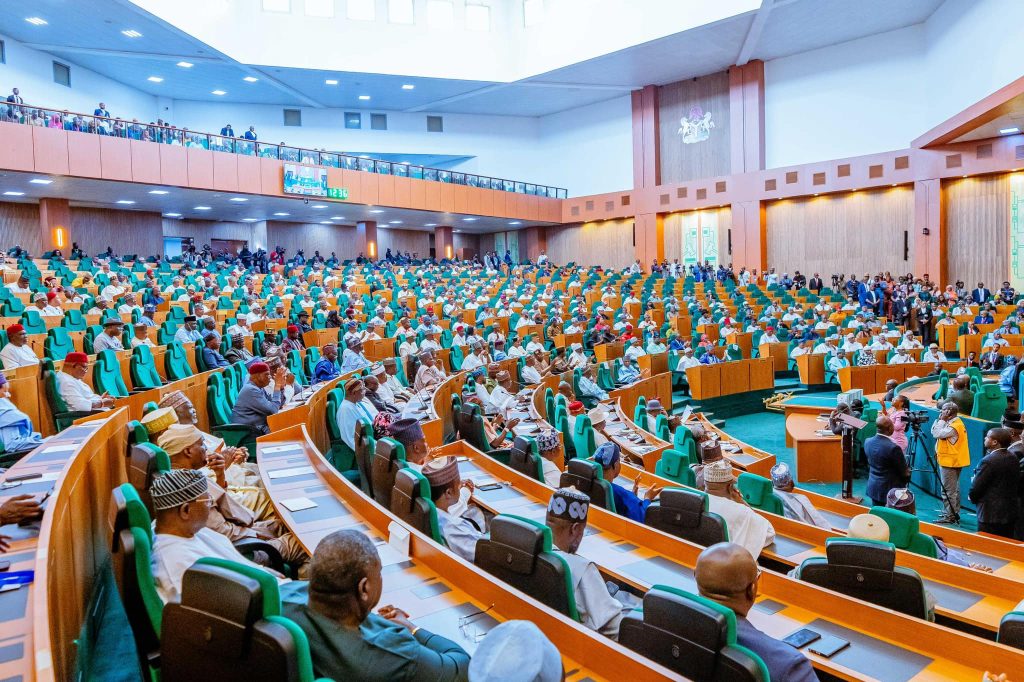
•Seek independent forensic audit of all reported off-budget expenditure •Frown on under-implementation of the 2024, 2025, 2026 Appropriation Acts •Lament constitutional controversy surrounding the State Police Alteration Bill Adedayo Akinwale in Abuja A group of bi-partisan lawmakers in the House of Representatives under the aegis of Save Nigeria Group has called upon the President of the Senate, Godswill Akpabio, and the Speaker of the House of Representatives, Hon. Tajudeen Abbas, to reconvene both Chambers immediately for an emergency session. The emergency session, the lawmakers said, must address the issue of under-implementation of the 2024, 2025 and 2026 Appropriation Acts; the constitutional controversy surrounding the State Police Constitutional Alteration Bill; and allegations of off-budget expenditure. Other issues they want the parliament to address as a matter of urgency included: non-release of capital funds to security agencies; the deteriorating security situation; and measures required to restore public confidence in the rule of law and democratic governance. The concerned lawmakers stated this in a statement issued Friday and jointly signed by Hon. Awaji-Inombek Abiante (NDC, Rivers); Hon. Abubakar Kusada, (APC, Katsina) and Hon. Mansur Jega (ADC, Kebbi) on behalf of the group. The lawmakers clarified that they are neither an opposition platform nor an instrument of any political interest, rather they are legislators increasingly alarmed by the direction of Nigeria’s democracy and the growing tendency of public institutions to subordinate the Constitution. The lawmakers lamented that Nigeria’s democracy is nosediving, adding that silence in the face of repeated constitutional violations and institutional failures could no longer be justified. They pointed out that the country is confronting an alarming disregard for the rule of law, chronic budget under-implementation, allegations of off-budget expenditure, worsening economic hardship and an unacceptable security situation. The concerned lawmakers emphasised that democracy cannot survive where constitutional procedures are treated as inconveniences and legal safeguards are replaced by political improvisation. They expressed concern over the emerging pattern in which constitutionally prescribed procedures are treated as optional. The lawmakers recalled that during the approval of the declaration of a state of emergency in Rivers State in March 2025, the National Assembly relied on voice votes despite the requirement under section 305(6) of the Constitution that the proclamation must be supported by a two-thirds majority of all members of each Chamber. They said more recently, serious constitutional and procedural questions arose from the purported passage of the Executive State Police Constitutional Alteration Bill by the House of Representatives on 23 July 2026. The lawmakers stated: “The Speaker announced that 311 members had voted in support of the Bill, thereby exceeding the constitutional threshold of 240 affirmative votes. “However, some of us were physically present throughout the proceedings and can state categorically that at no time that day were as many as 240 members in the Chamber, particularly when the Bill was considered. “The figure announced by the Speaker could only have been reached by including votes transmitted through WhatsApp by members who were absent from the Chamber at the material time.” The lawmakers stressed that Section 9(2) of the Constitution requires the affirmative votes of not less than two-thirds of all members of each Chamber before the Constitution can be altered. According to them, The mere announcement of figures by the Speaker cannot substitute for strict constitutional compliance. They added: “The Constitution cannot be altered by presumption, improvisation or undisclosed voting arrangements. “Democracy is endangered when a state of emergency can be approved through an unverifiable voice vote and the Constitution can purportedly be altered through WhatsApp messages. “State Police may be desirable, but a desirable reform must still be established through a lawful process.” The lawmakers further lamented that throughout the 2024, 2025 and 2026 fiscal cycles, Nigeria has experienced repeated budget extensions, rollovers and severe delays in capital implementation.They said in 2025, the federal government indicated that only approximately 30 per cent of the 2025 capital budget would be funded, while about 70 per cent would be carried forward into 2026.The lawmakers pointed out that it is no longer an occasional administrative delay, but a recurring breakdown of fiscal governance. They further recalled that Senate Chief Whip, Mohammed Monguno, p
Don't miss out on breaking stories and in-depth articles.