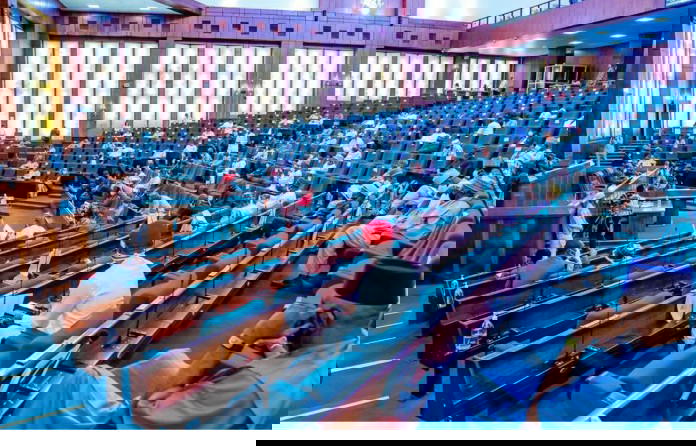
.Insist percentage-based system unfair to airlines Chinedu Eze The Airline Operators of Nigeria (AON) has called on the National Assembly to scrap the current five per cent Ticket Sales Charge (TSC) and replace it with a structure modelled on the Federal Airports Authority of Nigeria (FAAN)’s system of collecting passenger service charge (PSC), which is specific amount of money paid by passengers on every ticket. AON said the existing percentage-based system of collecting five per cent of the cost of every ticket was unfair to domestic airlines. The association made its position known yesterday at a public hearing on the proposed revision of the statutory sharing formula for the five per cent TSC, held at the Federal House of Representatives. The umbrella body, which was represented at the hearing by former Managing Director of the Nigerian Airspace Management Agency (NAMA), Capt. Roland Iyayi, said adopting the FAAN’s model of Passenger Service Charge will put to an end the controversy over debts emanating from non-payment of TSC to NCAA. Presenting the association’s position to the committee, the AON also argued that a flat charge like that of FAAN’s PSC, would remove the distortions created by a percentage levy applied indiscriminately to airline earnings, and put operators on more equal footing regardless of route or ticket pricing. The association also linked its call for reform to the sharp rise in fuel prices affecting airlines nationwide. It said domestic carriers have struggled to remit the five per cent charge to the NCAA since March, managing to do so only by shifting toward charter flights rather than sustaining regular scheduled operations. “The five per cent service charge has outlived its usefulness. It has become a burden on domestic airlines. We have made a submission on this. We have been proactive. As the AON, we have actually produced a document addressing institutional reform for the entire funding policy of the industry, and we will resolve it. So, essentially, what I am here to say, in a nutshell, is this: there are issues for consideration. “Beyond the five per cent charge, the AON recommends a different model. Rather than charging a percentage, we recommend adopting a structure similar to the one FAAN uses for the passenger service charge, because that creates a level playing field. Right now, the five per cent is charged on everything an airline earns. I’ll give an example: since March, we’ve experienced fuel shocks worldwide. The average fuel price increase elsewhere in the world was 60–80 per cent, but in Nigeria it was 270 per cent. “Since March, domestic airlines have not been able to pay the five per cent to the NCAA. We have managed to remit only because domestic airlines are now taking on charter flights to pick up loads rather than continuing scheduled flights. Essentially, ticket revenue is now going straight into fuel costs, fuel accounts for 40 per cent of an airline’s operating costs,” he said. The AON also raised concerns about how revenue collected by the Nigerian Civil Aviation Authority is being deployed. It noted that the NCAA collects fees on masts structures erected within the airspace, so that NAMA can produce low-level navigation charts. However, the association said the absence of such charts has left much of the country’s airspace underused, noting that helicopters in Nigeria currently cannot conduct low-level night flights. According to the association, aircraft capable of flying eight to 10 hours a day are being used for only about six hours because of inadequate infrastructure, a situation it said the NCAA’s practices have helped perpetuate. The AON further alleged that over the past 20 years, the NCAA has collected more than N10 billion from mast application fees and similar charges, funds it insisted should be reversed and properly accounted for. He said, “The NCAA collects fees on masts, structures erected in the airspace. The reason a mast’s geolocation is required is so that NAMA can produce low-level navigation charts. As we speak, helicopters in this country cannot conduct what is called low-level flight at night, and most of our airspace, because we lack low-level navigation charts, can scarcely be used. “So, the optimisation of aircraft assets by domestic airlines is significantly constrained, it’s important to acknowledge that we have operational limitations as the AON. Aircraft that could be flying eight to 10 hours a day are used for only about six hours, because of inadequate infrastructure. So, as I said, this practice by the NCAA needs to be reversed. “In fact, it is understood that over the last 20 years, the NCAA has collected over N10 billion from mast application fees and similar charges. That needs to be reversed.” While backing the bill to increase NAMA’s ea
Don't miss out on breaking stories and in-depth articles.