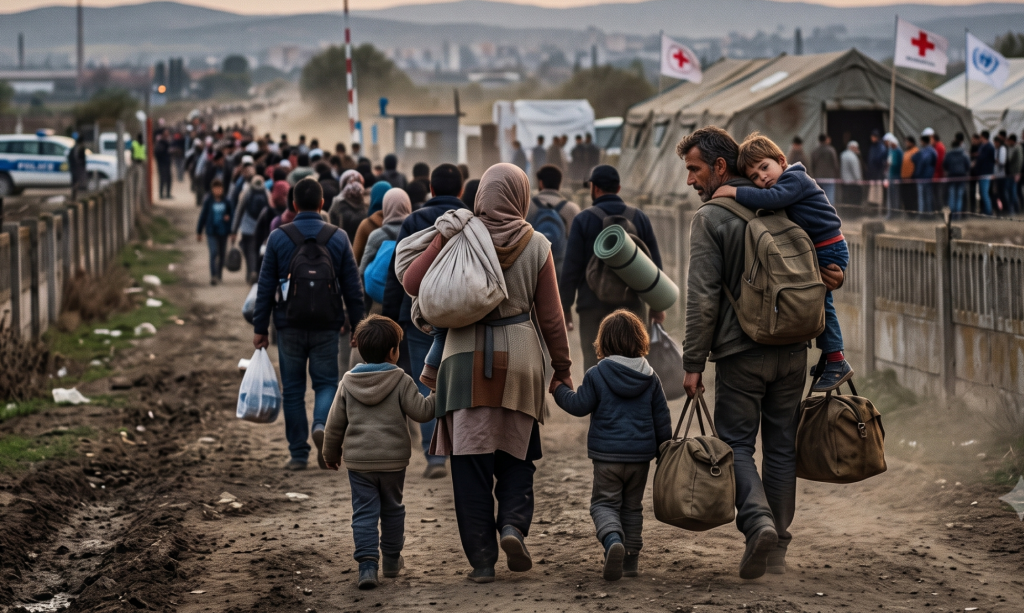
By Victor-Bandele Dada Human history has always been accompanied by migration. Communities have moved in search of fertile land, economic opportunity, political freedom, religious liberty, and security. Migration, in itself, is therefore neither abnormal nor undesirable. Throughout history it has contributed to cultural exchange, economic development, technological diffusion, and the advancement of civilizations. Forced migration, however, represents a fundamentally different phenomenon. It is migration without meaningful choice. Individuals, families, and entire communities are compelled to abandon their homes because remaining has become incompatible with safety, dignity, or survival. Armed conflict, terrorism, environmental degradation, climate change, economic collapse, political instability, communal violence, and development-induced displacement have collectively transformed forced migration into one of the defining humanitarian crises of our age (Castles, 2003; UNHCR, 2024). The scale of contemporary displacement is unprecedented in modern history. Tens of millions of people worldwide have been displaced within or across national borders. Nigeria itself continues to experience large-scale internal displacement arising from insurgency in the North-East, armed banditry in the North-West, communal conflicts in the Middle Belt, flooding, environmental pressures, and other forms of insecurity. These developments have generated profound humanitarian, economic, and governance challenges that extend far beyond the immediate needs of displaced populations (Internal Displacement Monitoring Centre [IDMC], 2024). Public discourse has largely concentrated on managing these humanitarian consequences through emergency relief, refugee protection, border management, and international assistance. These interventions are indispensable. Yet they remain predominantly reactive. Far less attention has been devoted to the deeper structural question: Why do communities continually produce displaced populations instead of producing sustainable prosperity? This article argues that this neglected question represents one of the most important research frontiers confronting contemporary scholarship. Defining the Emerging Humanitarian Time Bomb The expression humanitarian time bomb should not be understood as rhetorical exaggeration. Rather, it describes a measurable structural condition in which interacting trends increase the probability of systemic humanitarian failure if left unaddressed. The present crisis is defined by the convergence of three powerful global dynamics. First, the number of forcibly displaced people continues to increase as conflicts become more protracted, climate-related hazards intensify, fragile states struggle to maintain security, and demographic pressures grow. Humanitarian agencies face mounting demands that increasingly exceed available resources. Second, countries that historically absorbed significant numbers of migrants and refugees are adopting progressively more restrictive immigration and asylum policies. Governments cite border security, fiscal pressures, social integration challenges, labour-market considerations, and domestic political concerns as reasons for strengthening migration controls. Recent policy developments in several advanced economies-including tighter visa regimes, expanded border enforcement, and additional financial requirements for certain categories of travellers-illustrate a broader international trend toward more restrictive migration governance rather than expanding migration opportunities. Third, many migrant-producing countries continue to experience structural conditions that generate displacement faster than they can create sustainable livelihoods. Persistent insecurity, weak institutions, environmental degradation, inadequate local economic opportunities, and uneven regional development continue to encourage both internal and international migration. The significance of these developments lies not in any one trend individually but in their interaction. The world is simultaneously producing more displaced people while becoming less willing or less able to absorb them. This widening structural imbalance constitutes the emerging humanitarian time bomb. Unless scientific, institutional, and developmental solutions address the causes of displacement, humanitarian interventions alone will struggle to keep pace with expanding needs. Beyond Politics: The Forgotten Responsibility of Academia One of the most striking features of contemporary discussions on forced migration is the overwhelming tendency to assign responsibility almost exclusively to political leaders, security institutions, humanitarian organizations, and international development agencies. Governments are expected to formulate migration policies. International organizatio
Don't miss out on breaking stories and in-depth articles.