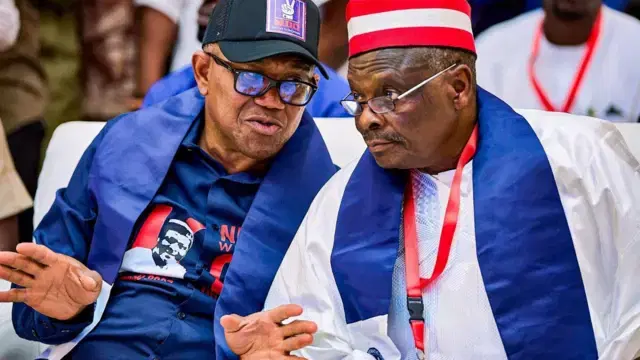
· Peter Obi can make a difference in four years, argues KALU OKORONKWO · In a political environment where the presidency is often treated as the ultimate prize: an office to be captured, consolidated and, where possible, retained, the proposition that a president could deliberately limit himself to a single term sounds less like conventional politics and more like a provocation. Yet, that is precisely what former Anambra State Governor and the presidential candidate of the Nigeria Democratic Congress (NDC), Mr. Peter Obi, has put on the table. · Predictably, the proposition has generated skepticism. Can four years be enough to govern Nigeria? Can a president confront insecurity, corruption, unemployment, infrastructure deficits, educational decay, healthcare challenges and an increasingly complicated economy within a single term? The answer to these questions is obviously no, but that may be a wrong question by all permutations. But there is a “but”. I shall come back to this. · The more important question is: Can one term of four years be enough to restart the country, repair her institutional decay and place her on a trajectory that succeeding administrations would find difficult to reverse? Or, put differently, what if four years is not enough to solve Nigeria’s problems but is sufficient to change the conditions that makes going back to the years of infamy practically impossible? · This is at the core of Obi’s one-term proposition: when leadership is measured by the tangibility of what is left behind at the end of an administration that makes it sacrilegious or treasonable by a new administration to go back to the old order. · History has a peculiar way of exposing the difference between occupying power and using power. Some leaders spend years protecting the office they hold; others use the limited time available to them to transform institutions, enthrone higher values and change the trajectory of the countries they lead away from the precipice to a more prosperous and egalitarian path. · Nelson Mandela epitomizes this type of leadership. When Mandela became South Africa’s first democratically elected president in 1994, he inherited a country emerging from the ruins of apartheid; a nation deeply divided along racial, political and economic lines. His presidency became one of the most consequential transitions in modern political history. Yet Mandela did not remain in office indefinitely. After a single term, he voluntarily relinquished the presidency. His major achievement was that he restored peace and set the nation on a path of irreversible healing after years of white supremacist regime. · Some may argue that South Africa was still deeply unequal when he left. Poverty had not disappeared, and the economic scars of apartheid remained. But Mandela had helped establish the foundations of a democratic order capable of outliving him. That distinction offers an important lens through which Nigeria should examine Peter Obi’s audacious one-term proposition. · At first glance, Obi’s proposition seems like a political harakiri in an environment where the campaign for a second term in office starts almost immediately as the rugs for the ceremonial swearing in of the president (and other elected office holders) is being rolled away from the venue. It is rarely regarded as a four-year national assignment. Most often, it is treated as an eight-year project, an entitled sacrosanct that is acceptable to all. We hear such statements as “there is no vacancy in Aso Rock Villa”; “the President should be allowed to continue the good work he has started”, etc., even in the face of obvious none performance by the incumbent. · Obi, however, appears to frame the presidency differently: as a finite national assignment rather than an indefinite political entitlement. And this is why his unprecedented one-term pledge is generating animated discourse in the polity. · The proposition deserves more than the predictable partisan dismissal that four years is too short, or that a politician promising not to seek a second term must really be desperate to occupy the office. The more serious issue is whether the quality of leadership can compensate, at least in part, for the brevity of tenure. Murtala Mohammed, a military head of state, ruled Nigeria for approximately six months (July 1975 to February 1976), yet his tenure is still a reference point in pragmatic leadership. His short term was extraordinarily consequential by the remarkable achievements recorded. He created new states, from 12 to 19; he proposed and established a panel to relocate all the federal capital from Lagos to Abuja, he carried out comprehensive civil service reforms, he committed to return Nigeria to civil rule in 1979, among others. These policies were so profou
Don't miss out on breaking stories and in-depth articles.