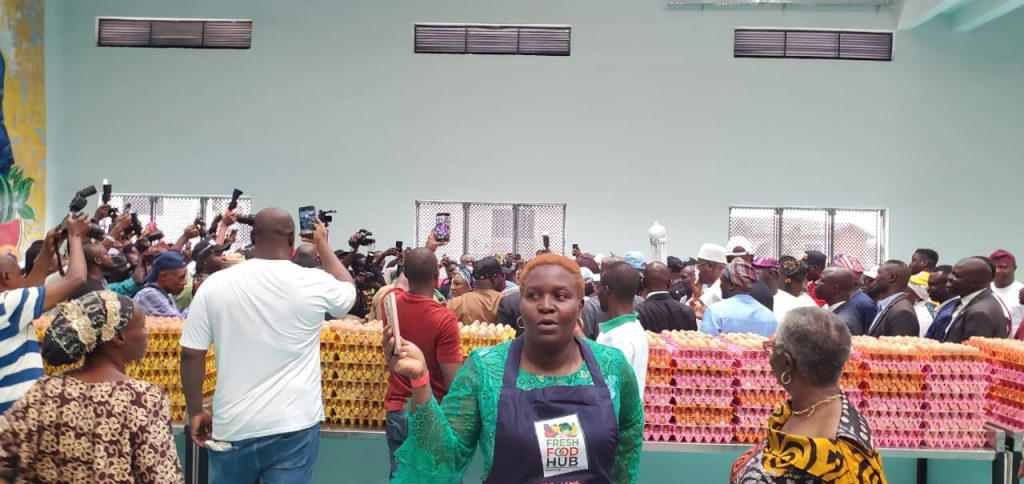
…Mushin hub records over N4bn transactions in three years By Olasunkanmi Akoni LAGOS — Lagos State Governor, Babajide Sanwo-Olu, on Wednesday inaugurated the Mid-Level Agro-Produce Hub at Pen Cinema, Agege, describing the facility as a key component of the state’s efforts to strengthen food security and reduce the cost of food for residents. Speaking at the inauguration, Sanwo-Olu said the hub was more than a market facility, describing it as part of the state’s broader strategy to transform the food system from production to distribution and consumption. “Today marks another important milestone in our collective journey to build a food-secure, economically vibrant, and resilient Lagos. “This facility represents our commitment to bringing modern food infrastructure closer to the people, to the communities where Lagosians buy, sell and consume food every day,” he said. The governor said Lagos’ food economy was valued at more than N16 trillion, while over 70 per cent of food consumed in the state was produced outside it. He identified high transportation costs, post-harvest losses, inadequate storage facilities and price volatility as some of the challenges affecting food distribution in the state. Sanwo-Olu said his administration launched the Lagos State Food Systems Transformation Agenda in 2021 to address the challenges. At the centre of the initiative, he said, was the Lagos Central Food Systems and Logistics Hub at Ketu-Ereyun, Epe, which is designed to become the largest food logistics hub in Sub-Saharan Africa when completed. According to him, the Epe hub is designed to handle more than 1.5 million metric tonnes of food annually and service over 1,500 food trucks daily. He said construction of the facility was at an advanced stage and would be commissioned before the end of his administration. The Agege facility is the third in the network of mid-level agro-produce hubs being developed by the state. The first, the Fresh Food Hub in Mushin, commissioned in December 2023, has recorded transactions worth more than N4 billion across 228 market days, with over 850 registered vendors and more than 7,000 direct and indirect jobs created. The second hub, located in Abijo, was commissioned earlier this year by President Bola Tinubu. “These hubs shorten supply chains, reduce unnecessary layers of intermediation, improve produce handling and make food distribution more efficient,” Sanwo-Olu said. The governor also highlighted the Produce for Lagos Programme, launched in July 2025 alongside a N500 billion Offtake Guarantee Fund. He said the programme was designed to shift agriculture from a supply-driven to a demand-driven model by guaranteeing farmers access to markets in Lagos, thereby addressing challenges relating to financing and market access. Sanwo-Olu disclosed that construction was ongoing at Opebi and Bombata, while additional hubs were planned for Ikorodu, Apapa, Festac and the Lekki axis. He said the long-term objective was to establish structured food hubs across all Local Government Areas and Local Council Development Areas in the state. Beyond infrastructure, the governor said more than 125,800 farmers and fishermen had been trained under his administration. He added that over 4,000 youths had been trained through the Lagos Agripreneurship Programme, while the Lagos Agric Scholars Programme was operating in more than 440 secondary schools. The Lagos Butchers Academy, he said, was also training meat processors in modern and hygienic practices. Sanwo-Olu cited the Lagos Rice Mill at Imota, described as Africa’s largest, saying it produced more than 250,000 50kg bags of Eko Rice in the past year, including the newly introduced Eko Fortified Rice aimed at addressing malnutrition. “May this hub bring prosperity to the traders who will work here, better prices to the farmers who will supply it, and fresh, affordable food to every family it serves,” he said. Facility to accommodate 400 vendors Commissioner for Agriculture and Food Systems, Abisola Olusanya, said the Agege hub was conceived as part of an interconnected food distribution network, with the Epe facility serving as the central hub and the mid-level hubs distributing food closer to communities. She said the Agege project was developed in partnership with Origin Tech Group, the project ideator and developer. According to Olusanya, the network was designed to address food losses resulting from poor handling and inadequate storage, congestion caused by food trading and transportation, and the poor conditions under which some traders operate. Sh
Don't miss out on breaking stories and in-depth articles.