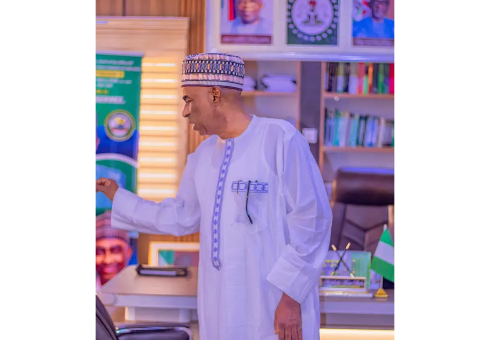
By Tunji Olaopa It was Mahatma Gandhi that once said, “The best way to find yourself is to lose yourself in the service of others.” And Gandhi was eminently qualified to know this. He was the embodiment of the struggle to restore the dignity and the progress of India from colonial dehumanization. Indeed, he gave himself to the service of Bharat Mata, or Mother India. The same can be said of the late octogenarian Alhaji Abubakar Alhaji—gentleman, diplomat, public servant, technocrat, expert, patriot, and elder statesman. To characterize Triple A, as he was fondly called, as a career civil servant is to compliment his dedication, excellence in service and commitment. It is to recognize someone whose public-spiritedness and professionalism defined the very essence of what it means to be in service to the state and the people. From 1964 when he joined the civil service till his retirement, he rose to become a permanent secretary, a federal minister and Nigeria’s high commissioner to the United Kingdom. That was a sterling trajectory of public service.However, the label of a career civil servant will not do justice to the full stretch of Alhaji’s patriotism as a public servant and his full-blooded humanity. In his person, he combined a love for the people and his community and a total and unflinching dedication to the service of the nation. That is a rare persona. And it takes someone who was close to him to unearth that personality. I encountered Alhaji Abubakar when he was already a permanent secretary emeritus and had made the transition to becoming a minister at the Ministry of National Planning and the Ministry of Finance and then as High Commissioner in the UK.Alhaji Abubakar Alhaji was a consummate civil servant and a professional bureaucrat to the core. Having studied political economy, Alhaji Abubakar Alhaji went the extra lengths to concretize his key expertise in economic and financial matters. And that expertise served him well during his very long tenure as a permanent secretary. That rise to the very top of the administrative ladder commenced as an assistant secretary at the Federal Ministry of Finance, then as a principal assistant secretary at the Ministry of Industries. He made the position of permanent secretary in 1975 at the Ministry of Trade from where he later again moved to the Ministry of Finance where he had a chance to deploy his economic knowledge in intervening Nigeria’s external creditors. He was later also a permanent secretary at the Ministry of Planning before the Babangida administration elevated him to the status of a Minister of State for Budget and Planning in 1988. He was indeed a Fellow and former President of the Nigerian Economic Society (NES).It was almost inevitable that Alhaji Abubakar, the economist and financial analyst, will find his way into the famous network of expert-professionals constituted by the President Ibrahim Babangida. The Presidential Advisory Committee (PAC) was a high-powered gathering chaired by the late Prof. Ojetunji Aboyade, and included others like Dr. Kalu Idika Kalu, Dr. Chu Okongwu, Dr. Michael Omolayole, HRM Olu Falae, Abdukadir Ahmed, Prof. Jonas Elaigwu, Prof. A. D. Yahaya, and others. The PAC was the think tank platform that was meant to deliver on policy advisory from the standpoint of deep professionalism that would deliver on policy-engaged research. This policy advisory professionalism was constituted around the solid technocratic expertise of core experts who met regularly to discuss and debate governance and policy matters that were meant to backstop good governance. In this particular instance, the entire intellectual and technocratic energies of PAC was concentrated on dissecting numerous policy concerns including one that would later have significant impact on my research; the policy implications of the Dotun Phillips Commission Report of 1985 and its metamorphosis into the Civil Service Reorganization Decree of 1988.The PAC had to figure out the administrative conundrum of how the Nigerian civil service system would fare in institutional terms when the parliamentary system was replaced with the presidentialism that the Babangida administration took on as his organizing framework for governance. Indeed, the discourse had to tie presidentialism not only to the structure and functioning of the civil service system but ultimately to the Nigerian state and Nigeria’s federalism. It was therefore a very significant moment in the Babangida administration; indeed, a testament to Babangida’s resourcefulness in gathering competences for the purpose of inducing governance and policy breakthrough. Something would have been amiss if Alhaji Abubakar Alhaji had not been inducted into this seminal space of high-caliber deliberation. He had what it took and contributed with remarkable erudition and panache to the debates and discourses at PAC. It was in that space of acute brainstorming that I cut my teeth as a policy analyst and implem
Don't miss out on breaking stories and in-depth articles.