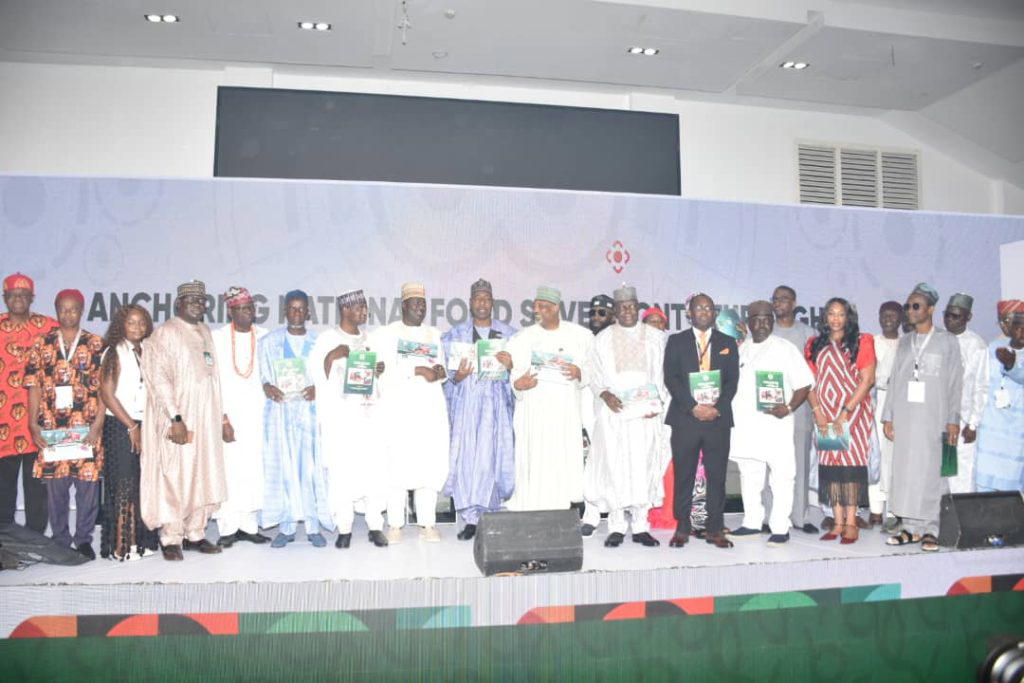
• New strategy targets machinery leasing, spare parts, digital fleet management, agro-processing James Emejo and Deborah Adekoya in Abuja Minister of Agriculture and Food Security, Senator Abubakar Kyari, yesterday unveiled a new National Agricultural Mechanisation Policy and National Agricultural Mechanisation Investment Strategy, to usher a commercially viable mechanisation ecosystem capable of driving food sovereignty and transforming agriculture. Speaking at a High-Level National Policy Dialogue on Agricultural Mechanisation in Abuja, the minister said the investment strategy included plans for a mega tractor assembly plant capable of producing between 2,000 and 4,000 tractors annually. He stressed that the country must move beyond tractor procurement, adding that the current administration was seeking to shift the country from fragmented public interventions to sustainable, private-sector-enabled mechanisation services. Kyari said the policy and investment strategy were designed to provide the framework for mobilising capital, technology, skills and entrepreneurship around agricultural mechanisation, while ensuring that machinery becomes accessible to farmers when and where it is needed. According to him, the federal government’s Renewed Hope National Agricultural Mechanisation Programme (RH-NAMP) had commenced the procurement and deployment of 2,000 tractors and more than 9,000 assorted implements and spare parts, describing it as the largest single agricultural mechanisation programme undertaken in Africa. The minister however, cautioned that the success of the intervention would not be measured by the number of tractors acquired. He said, “The real test is whether those machines become productive economic assets, maintained, financed, utilised, monitored and accessible to our farmers.” Kyari said modern mechanisation must cover the entire agricultural value chain, including land preparation, planting, irrigation, crop protection, harvesting, threshing, processing, storage, logistics and transportation. The facility, he said, was aimed at reducing the country’s dependence on imported machinery, developing domestic industrial capacity, creating jobs and establishing a sustainable mechanisation economy. The minister called on investors to see the emerging sector as more than an opportunity to supply tractors, saying that government was seeking long-term partners to build an agricultural technology and services ecosystem. Kyari said Nigeria’s large agricultural economy, expanding agro-processing activities, young population and unmet demand for machinery services provided a significant investment opportunity He added that young Nigerians, women and persons with disabilities would be integrated into the mechanisation economy as equipment operators, technicians, engineers, entrepreneurs, equipment managers and service providers. The minister cited Borno State as an example of what could be achieved when state governments commit to agricultural transformation, noting that Governor Babagana Zulum had distributed 200 truckloads of fertiliser and unlocked more than a dozen solar-powered irrigation systems. Kyari also singled out TracTrac Mechanization Services Limited for training young Nigerians as mechanisation service providers and deploying small-scale tractors to smallholder farmers. He stressed that government could not mechanise agriculture alone, assigning complementary roles to the federal government, states, private investors, financial institutions, development partners, research institutions and farmers. He said, “The federal government provides policy, standards, coordination and investment architecture, the States are to support with land access, infrastructure and implementation. The private sector is to invest, innovate and deliver services.” He added that financial institutions would need to develop appropriate financing, leasing and risk-sharing instruments, while development partners would provide catalytic finance, technical expertise and institutional support. Earlier, Permanent Secretary, Federal Ministry of Agriculture and Food Security, Dr. Marcus Ogunbiyi, said the country must confront its mechanisation deficit if it was to convert its agricultural potential into higher production, productivity and food security. Ogunbiyi said farmers had for too long endured inadequate machinery, high production drudgery, limited access to appropriate technologies and insufficient investment across the agricultural value chain. He, however, warned that tractors alone could not transform Nigerian agriculture. He said, “A tractor without an operator is an idle asset. A machine without maintenance is a depreciating investment. Equipment without finance cannot reach
Don't miss out on breaking stories and in-depth articles.