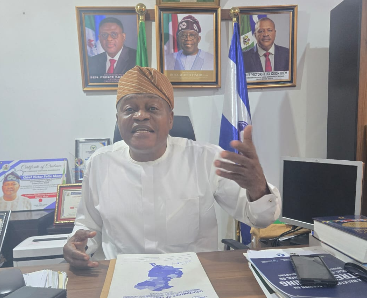
Politics has never been about occupying an office or enjoying the privileges that come with public positions for Mayor Dele Osinowo, the APC House of Representatives candidate for Kosofe Federal Constituency. Reflecting on his seven-year journey, he gave Adedayo Adejobi a glimpse of what local governance can achieve. It is just after 2 p.m. when Mayor Dele Osinowo walks into his office. The room is almost entirely white. White walls, white furniture and clean, contemporary lines give it a quiet sense of order. Tastefully chosen artwork breaks the monotony without disrupting the minimalist aesthetic. It feels more like the office of a corporate chief executive than a politician’s workspace. Nothing is out of place; every detail appears intentional. Osinowo settles into his chair with the ease of someone who knows every corner of the room. The conversation moves to politics, but not as an ambition fulfilled, rather as a responsibility that must continually justify itself. “I joined politics to make a difference,” he begins. “That has always been the motivation.” For him, politics has never been about occupying an office or enjoying the privileges that come with public positions. It has been about leaving behind measurable results such as projects, systems and institutions that outlive the tenure of the person who initiated them. “I have always been passionate about serving the people with sincerity of purpose,” he says. “Even though we are not there yet, my administration has tried its best in alleviating the needs of the people and addressing the infrastructural gaps in Agboyi-Ketu.” His political journey began in 1996. He left Nigeria for the United Kingdom, where he attended the University of East London and obtained a Bachelor’s degree in Business Studies before completing a Master’s in Risk Management. Those years abroad, he says, shaped his outlook and gave him exposure to systems of governance that would later influence his approach to leadership. When he returned to Nigeria in 2010, the political road was not immediately smooth. “I contested, but I didn’t get the ticket then,” he recalls. “That wasn’t the end of the journey.” Instead, he entered public service through local government administration. He was appointed Secretary to the Local Government and later became Vice Chairman of Kosofe Local Government under the late Obafemi Durosimi. “I learned from him,” Osinowo says. “Under him, I gleaned ideas and experience in governance. By the time I became Chairman, I was fully prepared.” That preparation became evident when he assumed office as Executive Chairman of Agboyi-Ketu LCDA. “I did not want to start building shops or markets alone. I came to do something different, unique and iconic. Projects that would allow people to distinguish me from others.” His administration’s most ambitious intervention was perhaps its housing programme, a project that sought to transform neglected areas while creating a sustainable development model. In Ajelogo, some public lands had become informal markets and hideouts for criminal elements. Rather than allowing those spaces to remain liabilities, Osinowo’s administration partnered with private developers. “We realised we had lands in Ajelogo being used as markets and criminal gang hideouts,” he explains. “We had to change the face of the community, so we reached out to developers, provided the land and went into a joint venture.” The result was a series of housing schemes that reshaped the landscape of the community. The administration delivered 271 housing units in one development, another 240 units in a second scheme, followed by 207 units and another 256-unit project. Three major estates, namely Greenwich Gardens, Sterling Heights and Raymond Estate, were commissioned, while Greenwich Phase II commenced in November 2024 and was completed and handed over. For Osinowo, the housing projects were part of a broader strategy to address one of the biggest challenges facing local governments: revenue generation. “Poor revenue generation was part of my motivation coming into office,” he says. “Because our projects are in the form of equity participation, on completion each partner gets their units. What we get forms part of our revenue.” His administration also embraced technology to modernise revenue collection. A GPS-based mapping system was introduced to identify commercial properties across the LCDA, bringing transparency and accountability into the process. “All lock-up shops, car wash centres and commercial buildings in the local government have coordinates. We can easily know businesses that have paid.” The system, he explains, eliminated duplication and simplified payments. “We’ve simplified re
Don't miss out on breaking stories and in-depth articles.