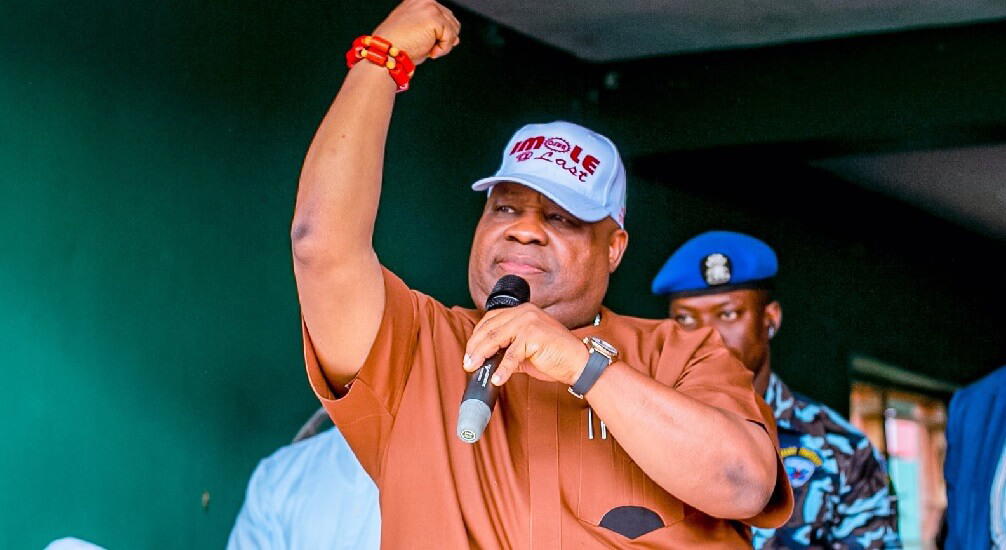
The All Progressives Congress (APC) may have entered the Osun governorship election believing it was fighting Governor Ademola Adeleke. In the end, however, it may have been fighting something far more difficult to defeat: public sympathy. Adeleke’s victory was decisive. The Accord Party candidate polled 511,067 votes, defeating the APC candidate, Bola Oyebamiji, who scored 444,815 votes. Adeleke won 19 of the state’s 30 local government areas, securing another four years in office. The result should not be reduced to dancing, celebrity appeal or the strength of the Adeleke family name. Those factors may have contributed to his popularity, but elections are rarely won on a single issue. Sometimes, an opponent’s mistakes become a candidate’s most powerful campaign weapon. That appears to have happened in Osun. The APC had considerable advantages. It had the Federal Government behind it, a formidable political structure, influential national figures and a candidate it presented as experienced and technocratic. Yet, somewhere along the campaign trail, the party appeared to lose control of the narrative. Instead of making the election principally about Adeleke’s record, the APC increasingly found itself defending the atmosphere surrounding its own campaign. And that may have been its biggest mistake. EFCC CONTROVERSY efcc One of the major setbacks was the controversy surrounding the Economic and Financial Crimes Commission’s restriction on the accounts of the Osun State Government. The timing could hardly have been more politically sensitive. The EFCC’s action came only days before the election and immediately became a campaign issue. Adeleke accused the commission of attempting to cripple his administration ahead of the poll, while the APC accused the state government of financial misconduct and called for investigations. There may have been legitimate legal and investigative reasons for the EFCC’s action. But elections are not fought in courtrooms alone. They are fought in the court of public perception. And the perception created by the timing was politically damaging. To Adeleke’s supporters, the development was easy to frame as an attempt by the Federal Government to weaken an opposition-controlled state immediately before an election. Once that narrative took hold, the APC had a difficult task convincing voters that the matter had nothing to do with the election. Then came President Bola Tinubu’s intervention. The President directed that the restriction on the state’s account be lifted, a development that complicated the political optics even further. The questions practically wrote themselves: If the restriction was necessary, why was it reversed so close to the election? And if it was unnecessary, why was it imposed in the first place? Those questions may have little bearing on the legal merits of the EFCC’s action, but politically, they were devastating. The APC had inadvertently handed Adeleke an opportunity to present himself as a governor under pressure from a powerful Federal Government. For an incumbent seeking re-election, that is a valuable political narrative. WHEN RELIGION ENETRED THE RACE The second problem was religion. There is nothing inherently wrong with a politician consulting religious leaders or seeking their prayers and support. Oyebamiji did so, including meetings with Muslim leaders and organisations that publicly backed his candidacy. The difficulty was the interpretation those engagements generated. Osun is a religiously diverse state with a long tradition of coexistence between Muslims and Christians. Any political campaign that appears to transform a governorship contest into a religious competition risks creating anxiety among voters. The APC did not necessarily create all the religious narratives surrounding the election, but it did not appear to sufficiently control them either. That was a costly mistake. The election should have been dominated by questions about roads, schools, jobs, healthcare, security, infrastructure and the performance of the incumbent. Instead, religion became part of the conversation. And once religion enters an election, rational arguments about policy can quickly become secondary. A candidate can lose votes not because voters oppose him personally, but because they fear what they believe his victory represents. MISUSE OF FEDERAL POWER The APC also appeared to underestimate the danger of making federal power part of its campaign argument. There were moments when the party’s message appeared to suggest that Osun would benefit from aligning itself with the Federal Government and APC-controlled states. On paper, the argument is straightforward: a governor who belongs to the same party as the President may find it easier to attract federal attention, projects and resources. But politically, the message can easily be interpreted differently. Voters may hear: “Support us because we control Abuja.” That is a dangerous proposition
Don't miss out on breaking stories and in-depth articles.