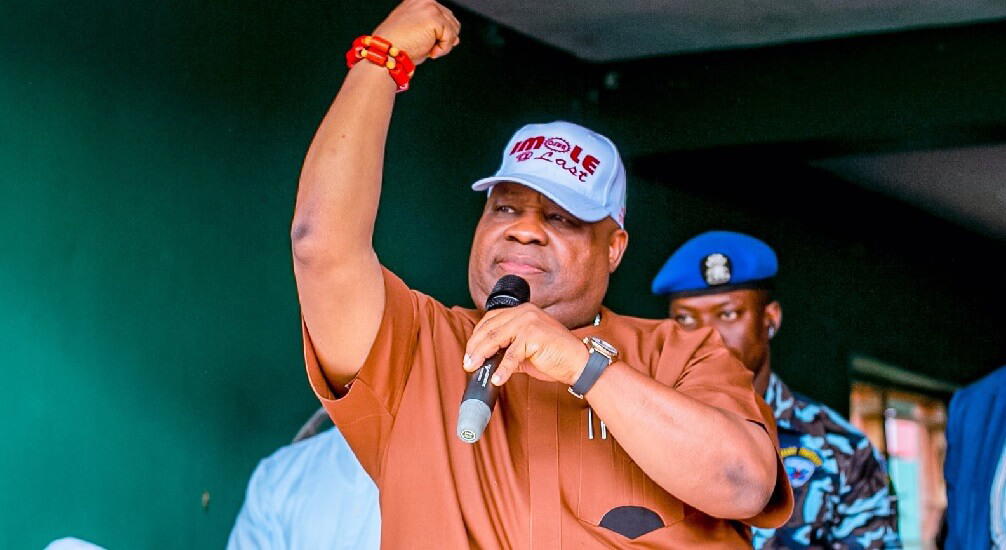
With the official declaration of Governor Ademola Nurudeen Jackson Adeleke, of the Accord Party as winner of Saturday’s governorship election in the state by the Independent National Electoral Commission (INEC), the long battle over who will steer the affairs of the state in the next four years has been decided. It was a contest in which 15 political parties participated but which, on the day of the election, proved to be a three-horse race for the candidates of the Accord Party, Adeleke; the All Progressives Congress (APC) candidate, Asiwaju Munirudeen Bola Oyebamiji and the African Democratic Congress (ADC) candidate, Najeem Folasayo Salaam. INEC Chief Returning Officer, Professor Joshua Ogunwole, while announcing the final results, said Adeleke polled a total of 511,067 votes, while his close rival, Bola Oyebamiji of the APC, polled 444,815 votes and Salaam of ADC got 17,180 votes. Reacting to his victory, Adeleke appealed for restoration of peace and unity among Osun people to heal the wounds of pre-election violence, even as he promised to expand state development and widen the nets of good governance. Addressing the media after his victory, the governor commended President Bola Ahmed Tinubu for his strong support for a free and fair election. Adeleke said, “Mr President is a son of Osun State, and I hereby reaffirm my earlier endorsement of him for a second term in the 2027 presidential election. To all lovers of democracy, I thank you for supporting our struggle. From home and abroad, the support is overwhelming. My faith in democracy is deepened.” Our correspondents report that the re-election struggle of Adeleke had not been a tea party. From the crisis in his former party, the People’s Democratic Party, which escalated to the point that he had to defect to the Accord Party, to the litigation around the eligibility of the Accord Party to field a candidate, Adeleke eventually scaled the hurdles and met INEC requirements to be on the ballot for the election. Still, the pre-election stage was characterised by political violence in which many were killed and several others injured, with both the Accord and APC trading allegations and counter-allegations over the violent attacks during the campaign period. Because of the tense situation in the state, there was massive deployment of security personnel to ensure the safety of lives, particularly the electorate, INEC officials and election observers. On election day, however, our correspondent observed how residents defied threats of violence and came out in large numbers to cast their ballots, leading to a fairly large turnout of voters across the state, while electoral officials also arrived at polling units on time, with security operatives also promptly on the ground. Governor Ademola Adeleke Daily Trust reports that though the BVAS machine worked perfectly in most parts of the state, there were instances where the machines caused delay and slowed down the process. However, eligible voters who came out were able to vote for candidates of their choice. The results released indicate an increase in Adeleke’s political scope and an improvement over his performance in the 2022 governorship election. In the 2022 election, Adeleke got 403,371 votes to defeat the then incumbent APC governor and now Minister of Marine and Blue Economy, Alhaji Isiaka Adegboyega Oyetola who got 375,027 votes (a margin of 28,344 votes) but in 2026, the margin has widened to 66,252 votes, more than doubling his winning margin in the previouselection. Out of the 30 local government areas in the state, Adeleke won in 19, recording an improvement on that of 2022 in which he won in 17 out of the 30 LGAs in the state. A further breakdown of the figures shows that while APC mobilised more votes than in 2022, Adeleke mobilised considerably more. Adeleke obtained about 51.9% of valid votes in the current polls, compared with about 50.1% in 2022. Oyebamiji, however, obtained about 45.2%, compared with Oyetola’s 46.6% in 2022. Factors that aided Adeleke’s victory Some of the factors that worked in favour of the Accord Party candidate according to analysts include workers’ welfare where the Governor has earned the support of the civil servants in the state because of prompt payment of salaries and pension; infrastructural development – though, people say he concentrated development in his home town of Ede – and the divisions within the APC, particularly because of the way Oyebamiji emerged as the candidate of the party. Though none of the governorship aspirants left APC officially, many of them were still aggrieved and their supporters left the party and worked for Adeleke. For instance, the former Deputy Governor, Senator Iyiola Omisore, who was among the Governor aspirants disqualified, was aggrieved. Though Omisore did not leave the party, his followers moved to the Accord. This is reflected in the results from Omisore’s stronghold in Ife, which APC lost. Prof. Olaleye K
Don't miss out on breaking stories and in-depth articles.