
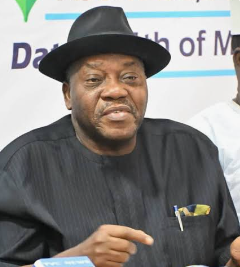
— PANDEF chair seeks restructuring, 15-region federation proposed By Henry Umoru ABUJA — The National Chairman of the Pan Niger Delta Forum, PANDEF, Ambassador Godknows Igali, has called for the restoration of fiscal federalism and greater devolution of powers to Nigeria’s regions, warning that excessive concentration of political and economic powers in Abuja is weakening the country’s productive capacity. Igali also criticised governors for what he described as turning regional cooperation into “jamboree”, urging them to move beyond meetings and ceremonies and establish economic partnerships capable of generating wealth and employment. He spoke on Monday in Abuja at a national dialogue organised by the Citizens Rebirth & Awareness Initiative, C-RAIN, ahead of the Citizens Assembly on Restructuring of Nigeria’s Federated Regions. According to Igali, Nigeria’s over-centralised system has weakened productivity, accountability and security, while the monthly Federation Account allocation system has created a culture of dependence among states. “FAAC has made governors CEOs of ‘allocation sharing’. Decree 43 made us lazy and dependent on oil. Fiscal federalism will make them CEOs of production,” he said. He urged governors to deepen economic cooperation across their respective regions by investing in productive ventures rather than limiting their activities to meetings. “Why can’t they operate as a region to invest in the centre? Not just going off eating, wearing the same clothes and all the other things,” he said. Igali said Nigeria’s founding fathers deliberately adopted federalism because they understood that the country’s diversity could thrive when its constituent parts had sufficient autonomy, resources and incentives to develop. He argued that successive military interventions, particularly from 1966, progressively weakened the federal structure by concentrating powers and resources at the centre and making states increasingly dependent on federal allocations. “From the outset, let me state clearly, we from PANDEF are gathered here today not to divide Nigeria, but to save her. We are gathered not to weaken the centre, but to strengthen the federation,” he said. According to him, Nigeria does not necessarily need to disintegrate but must stop operating a system in which virtually everything passes through Abuja. “We must correct the damage of 1966. Nigeria does not necessarily need to break apart; it needs to stop being run as though everything must pass through Abuja. “We destroyed what was working,” he said. Igali recalled the era of regional governments when the Western, Northern and Eastern regions competed in agriculture, education, industrialisation and infrastructure, arguing that the system created incentives for governments to generate revenue and develop their economies. “Where are the pyramids?” he asked, referring to the agricultural production that once characterised parts of Northern Nigeria. He said the disappearance of such productive activities reflected a structural shift from a system that rewarded production to one that increasingly rewarded access to federal revenue. “Nobody should wait for Abuja every month,” Igali warned, arguing that the allocation culture had weakened accountability and discouraged states from developing sustainable economic bases. He urged states to identify their comparative advantages and build productive economies around them, stressing that federalism should not mean 36 states competing for a share of revenue generated largely from the centre. Igali recalled that the old Western Region developed free primary education and Cocoa House, while the Eastern Region built industries and the Northern Region developed agriculture and educational institutions. “And it worked,” he said, stressing that the regions achieved those feats without depending on monthly allocations from the centre. “That was the dream: a federation of strong, productive units paying dues to a limited but effective centre,” he said. The PANDEF chairman also advocated greater regional collaboration in infrastructure, power, security and other areas of economic development, citing the potential for stronger partnerships among states in the South-West, South-South and South-East. He called for state police, arguing that Nigeria’s security challenges required local intelligence and responses. “Banditry in the Northwest, kidnapping in the Southeast, farmer-herder clashes in the Northcentral all require local intelligence and local response. You cannot do that from Abuja,” he said. Citing countries including the United States, Canada, Germany, Switz
Don't miss out on breaking stories and in-depth articles.


