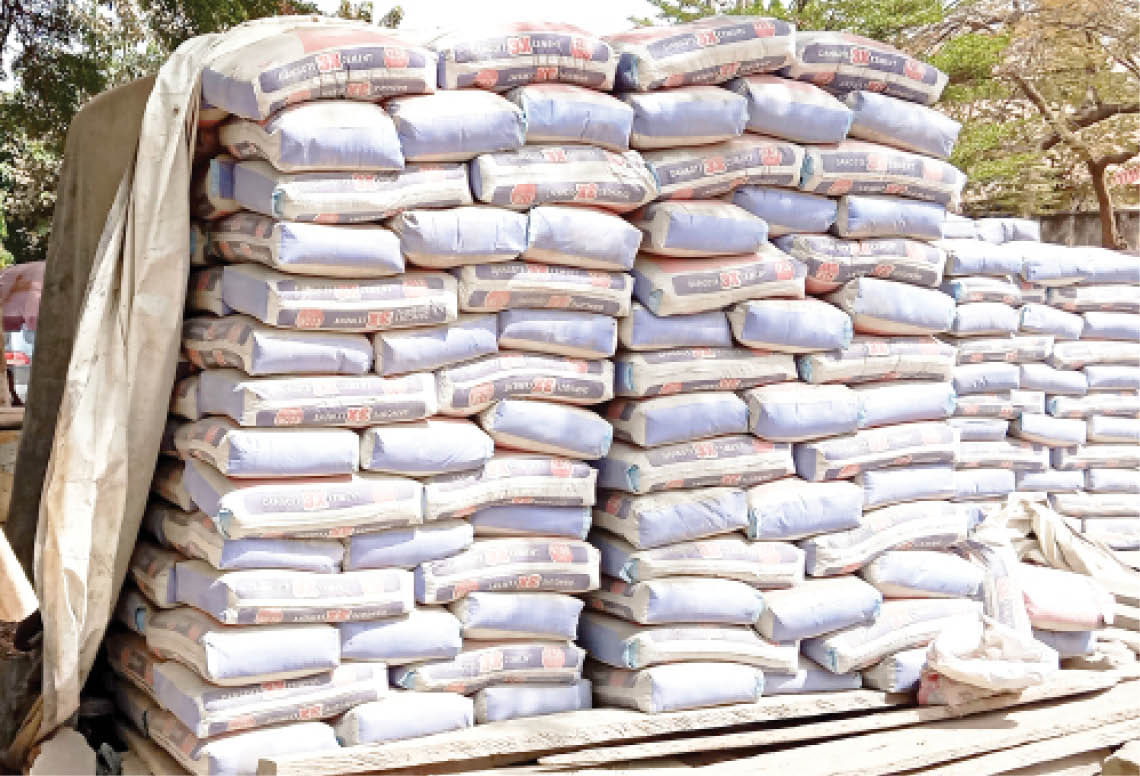
• Tunji Bello: intervention not to dictate commercial decisions but protect competitive process James Emejo and Debora Adekoya in Abuja The Federal Competition and Consumer Protection Commission (FCCPC), yesterday, announced the commencement of fresh probe into the Nigerian cement market following preliminary findings suggesting possible manipulation of prices despite substantial domestic production capacity and reported excess supply. FCCPC said its three-month cross-border investigation established sufficient grounds to probe whether the prevailing prices of cement were driven by legitimate production and market costs or possible anti-competitive conduct among major industry players. The consumer rights commission disclosed the development in a statement issued by its Director, Corporate Affairs, Mr. Ondaje Ijagwu, in Abuja. The intervention came amid widespread complaints over the high cost of cement in the country. The commission’s Anticompetitive Practices Department (ACP) is conducting the fresh probe based on a 40-page industry-wide field investigation report covering Nigeria and selected cement markets across Sub-Saharan Africa and North Africa. The investigation is particularly focused on the apparent disconnect between the country’s production capacity and the prices consumers continue to pay for cement. Explaining the probe, Executive Vice Chairman/Chief Executive of FCCPC, Mr. Tunji Bello, said the commission was acting within its mandate to examine market conditions with significant consequences for consumers and the wider economy. Bello said cement was too central to housing, commercial development, public infrastructure, and the cost of doing business for the commission to ignore amid persistent concerns about its pricing. He said FCCPC’s responsibility was to move beyond assumptions and establish the facts surrounding the working of the market. He said, “Cement occupies a strategic place in the Nigerian economy. Its price affects the cost of building a home, developing commercial property, delivering public infrastructure and, ultimately, the cost of doing business. “When concerns persist about how such an important market is functioning, the Commission has a duty to look beyond assumptions and establish the facts. “Businesses are entitled to make legitimate commercial decisions and earn returns on their investments. Competition law does not prevent that.” Bello stressed that the investigation should not be interpreted as an attempt by the regulator to dictate the commercial decisions of cement manufacturers. Rather, Bello said, the focus was on determining whether the market was operating competitively and whether consumers were benefiting from competition. He added that the law was designed to protect the competitive process so that prices, output, and other market outcomes would be driven by genuine competition rather than unlawful restrictions. He said, “That distinction is important to the work we are undertaking.” According to the FCCPC, Nigeria has installed cement production capacity of about to 65 million metric tonnes annually, against estimated domestic consumption of between 25 and 30 million metric tonnes. The country is also a net exporter of cement to neighbouring markets. FCCPC observed that the reported excess capacity had not produced the downward pressure on domestic prices that would ordinarily be expected in a competitive market. The price movement had been particularly sharp in 2026. Market intelligence reviewed by the commission showed that a 50kg bag of cement, which sold for between N9,300 and N9,700 in January, had risen to between N10,500 and N13,000 by mid-year, while prices of between N13,000 and N15,000 were reported in some parts of the country by July. FCCPC said the preliminary findings had raised questions requiring further examination, particularly given the country’s substantial limestone deposits, domestic production base, and installed capacity, relative to consumption. The investigation also examined comparable markets, including Kenya, Tanzania, Togo, South Africa, Egypt, Morocco, and Algeria, using variables, such as, limestone availability, population, production capacity, and domestic consumption. In Kenya, which has a population of 58.6 million, about 76 per cent lower than Nigeria’s, domestic cement demand was about 9.3 million metric tonnes in 2025, while a bag of cement sold for about $5.40, equivalent to N7,344. Tanzania, with a population of 66.3 million and similar cement demand of about 9.3 million metric tonnes in 2025, recorded a retail price of about $4.80, or N6,528, according to the commission. In Togo, where there is no limestone deposit, a bag
Don't miss out on breaking stories and in-depth articles.