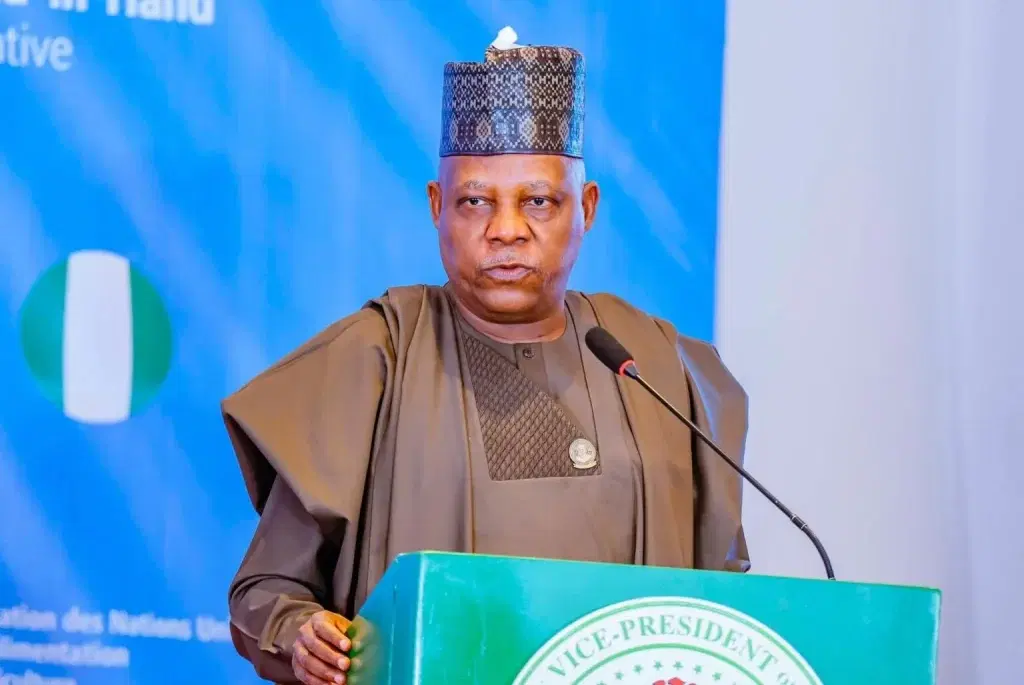
Vice President Kashim Shettima has declared that Nigeria cannot afford to exclude women from its plan of building a $1 trillion economy, adding that women’s economic inclusion is key for national growth. Shettima stated this at the Presidential Villa on Wednesday during the Second National Gender Inclusion Conference, #ProjectShesIncluded organised by the Presidential Committee on Economic Inclusion in the Office of the Vice President. The Vice President represented at by his Special Adviser on Special Duties, Aliyu Moddibo, said the Federal Government’s ambition of building a one-trillion-dollar economy would remain incomplete if women were unable to participate fully in creating wealth and driving economic growth across the country. “We have set our sights on a one-trillion-dollar economy. But what kind of economy can we build if half of our people cannot participate fully in creating it?” he asked. Shettima noted that only 47 per cent of women hold formal financial accounts, compared with 58 per cent of their menfolk, describing the gap as evidence of women whose businesses cannot access affordable capital and female farmers unable to insure their livelihoods. He said the question is “no longer whether we can afford to invest in women, it is whether we can afford not to.” The Vice President said the government was developing an architecture for delivering economic inclusion, citing the National Income Activation Initiative, which he said was taking skills, capital and market access to women and young people across the country. He also highlighted the Women in Energy Partnership with the World Bank as an initiative positioning women to participate in Nigeria’s energy transition. Shettima said government must move beyond national averages and focus on identifying those still excluded from economic opportunities. He challenged stakeholders at the conference to ensure that every commitment made carries an owner, a measurable target and a deadline. On his part, Deputy Chief of Staff to the President, Senator Ibrahim Hadejia, said the #SheIsIncluded initiative must move beyond an annual campaign and become an enduring national delivery framework for women’s economic prosperity. He said the financial exclusion of women represented productive capacity that Nigeria could no longer afford to leave idle. “These inequalities represent productive capacity our economy is yet to activate. Every viable woman-led enterprise that cannot obtain financing is investment lost, and every young woman with skills but no pathway to formal employment or entrepreneurial opportunity represents human capital underused. “A nation aspiring for a one-trillion-dollar economy cannot afford to leave the productive capacity of half its population idle,” Hadeija said. The Governor of Jigawa State, Umar Namadi, represented by the state Commissioner for Women Affairs, Hon. Hadiza Abduwahab, reaffirmed the state’s strong commitment to the Federal Government’s efforts to ensure that financial inclusion for all genders translates into practical and measurable results. The governor highlighted that the Renewed Hope Agenda “has gained strong momentum” in all facets, including financial inclusion for women. Also speaking, the Minister of Women Affairs and Social Development, Hajiya Imaan Sulaiman-Ibrahim, said the $1 trillion ambition would remain incomplete unless women, particularly those operating in the informal sector, were fully integrated into the economic transformation agenda. She identified poor last-mile delivery, unsuitable lending models, inadequate gender-disaggregated data, insecurity and unpaid care work as major barriers to women’s economic participation. Also speaking, Technical Adviser to the President on Economic and Financial Inclusion, Dr. Nurudeen Abubakar Zauro, provided a clear outline of the government’s new delivery strategy, announcing four platforms aimed at transforming financial inclusion into measurable economic participation. He identified the platforms as digital trust infrastructure, data for accountability, blended finance and the National Income Activation Initiative. Citing EFInA data, Zauro said Nigeria’s overall financial inclusion rate stood at 74 per cent of adults, but a nine-percentage-point gender gap persisted, while the disparity in formal access stood at 11 percentage points.
Don't miss out on breaking stories and in-depth articles.