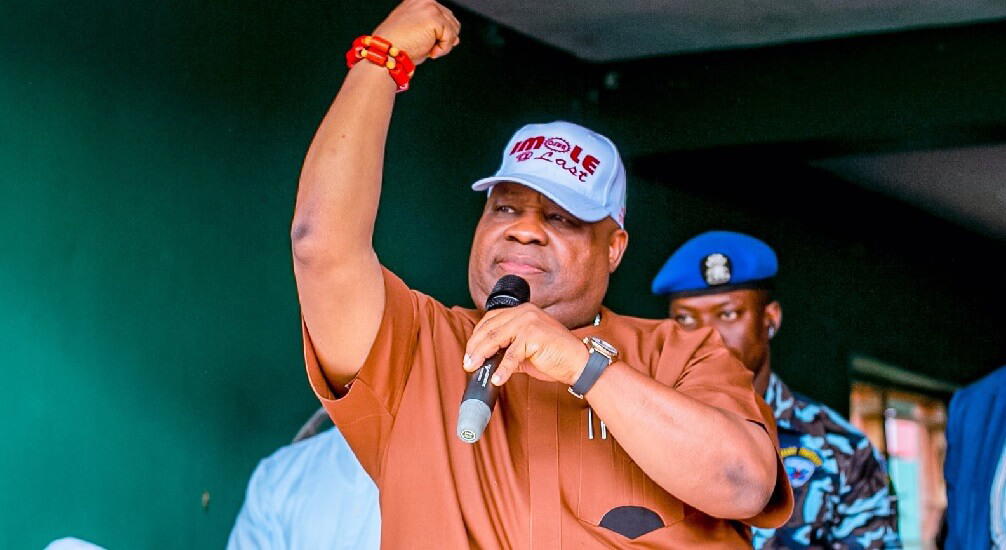
Olusegun Adeniyi The biggest losers in the Osun State gubernatorial election are the All Progressives Congress (APC) National Chairman, Prof. Nentawe Yilwatda and the Minister of Marine and Blue Economy, Mr Adegboyega Oyetola. For Yilwatda, his 276-member campaign council of “political heavyweights” was crushed by the dancing feet of Governor Ademola Adeleke. Despite boasting that the contest would end like “a trailer facing a Keke (bicycle)”, he was humbled by Osun voters. Had Yillwatda listened to his ownSpecial Adviser on Media and Strategy, Abimbola Tooki, he would have known that Oyetola and his proxy candidate, Mr Bola Oyebamiji (a respected professional in his own right) were no match for the ‘Ajobiewe’ of Ede. But now that the election has been lost and won, we should all be worried by what transpired in Osun State. By the conventional indicators Nigeria uses to evaluate electoral success, the process appeared to have delivered. Votes were cast and properly counted. And the winner was determined by daybreak. But the more consequential question is what the election required in human, institutional, and material terms, and whether the Nigerian state is prepared to account for those costs. The first cost is measured in lives. Let’s begin with the dead. On 12 August, three days before the election, Ayegbo Oluwadele was shot near a family compound in Esa-Oke, Obokun Local Government Area. On 6 July, Timilehin Oni, a 19-year-old who would have been participating in his first governorship election, was shot dead in Ijebu-Jesa. These deaths were not isolated incidents; they formed part of a wider pattern of election-related violence reported across a state where a serving Senator introduced a new refrain, ‘Pi pa ni o’ which literally translates into a license to kill political opponents. How many lives were lost to the election? Here we arrive at the first scandal. The Kimpact Development Initiative recorded 73 election-related incidents and 29 deaths. YIAGA Africa’s Samson Itodo placed the death toll above 35. The Nigeria Police Force reported at least 30 politically motivated killings, while the Centre for Journalism Innovation and Development recorded 18. The APC reported ten members killed; the Accord Party reported fifteen. The disparity reveals a serious weakness in Nigeria’s capacity to document electoral violence. The country can record electoral outcomes with extraordinary precision while failing to establish, with comparable certainty, how many citizens died in the same electoral process. Votes are subjected to meticulous enumeration while deaths are reduced to competing estimates. No one should pretend that this was a crime by one political party. Members of the two major political camps were among the dead, while both have faced allegations of mobilizing or arming young people for political purposes. Let’s now consider what it took to hold the ring. For a single electoral day in a single state, approximately 25,310 security personnel were deployed: 15,000 police officers, 10,210 personnel from the Nigeria Security and Civil Defence Corps (NSCDC), and over 100 Economic and Financial Crimes Commission (EFCC) operatives. A Deputy Inspector-General of Police was deployed to coordinate operations while 30 Police Commissioners were assigned across the state’s 30 local government areas. Helicopters and drones were used for surveillance. The Army restricted movement into and within the state from midnight, with exemptions for essential services and voters. Even if we ignore the enormous financial cost involved at a period most Nigerians struggle to eke out a living, the scale of this deployment amounted to roughly seven security personnel for every polling unit and approximately one security officer for every 40 votes eventually cast. Meanwhile, farmers in several states face insecurity on routes to their fields; and travellers along major corridors remain exposed to kidnapping and other forms of violence. The issue is therefore not the availability of state capacity to address the challenge of insecurity. It is about the allocation of that capacity. Osun demonstrated what the Nigerian state can accomplish when political stakes are sufficiently high. The unresolved question is why comparable urgency is not consistently applied to the protection of citizens outside electoral periods. Then there was the ‘migration’. In the final week of the campaign, senior political figures from across the federation converged in Osogbo. No fewer than six APC Governors were in Osun State with their retinue of aides. The senate president and his deputy were also on ground along with numerous National Assembly members. These actors exercised considerable influence over the campaign environment, despite the fact that none was an eligible voter in Osun State. But here is the lesson of it all: The full weight of the APC federal might was placed on on
Don't miss out on breaking stories and in-depth articles.