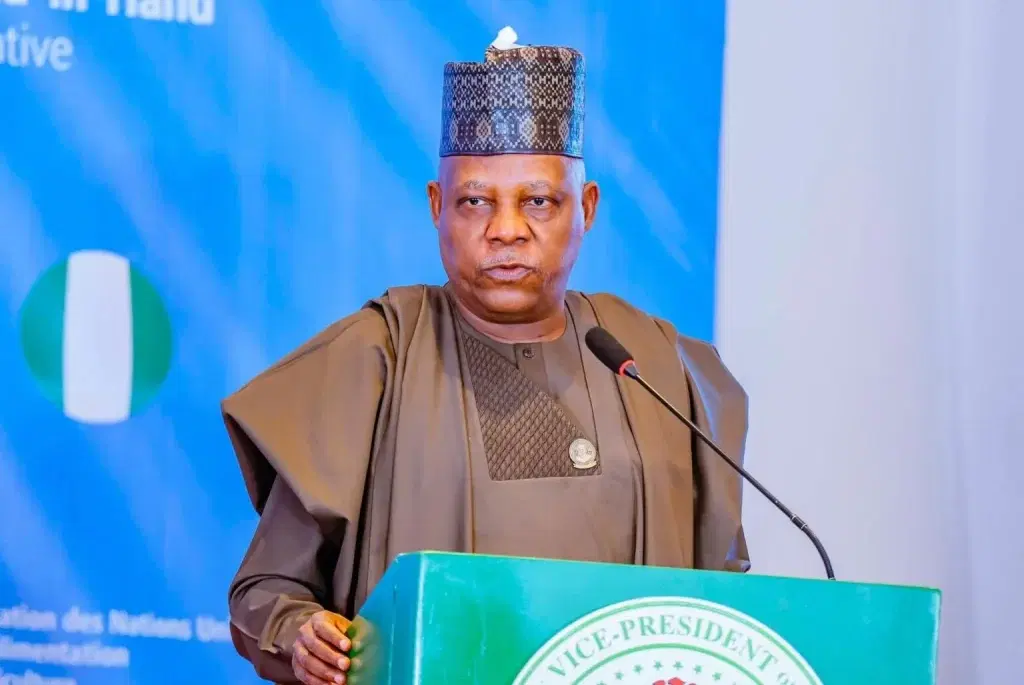
• Says women’s inclusion not charity but growth strategy •FG unveils four platforms to close gender finance gap, targets 4.5m women through empowerment programme Deji Elumoye in Abuja The presidency yesterday warned that Nigeria’s ambition to build a $1 trillion economy could not be achieved without the full economic participation of women. Vice President Kashim Shettima made the assertion while declaring open the Second National Gender Inclusion Conference, #SheIsIncluded 2026. As part of efforts enhance women’s economic participation, the federal government said it had unveiled four strategic platforms to bridge the gender gap in financial inclusion and turn women’s economic potential into enterprise, jobs, and sustainable growth. Minister of Women Affairs and Social Development, Hajiya Imaan Sulaiman-Ibrahim, who disclosed this at the conference, said the scheme had been expanded to target 4.5 women nationwide. The event held at Banquet Hall of State House, Abuja, was organised by Presidential Committee on Economic Inclusion in the Office of the Vice President, with the theme, “Designing for Delivery: From Financial Inclusion to Economic Transformation for the Nigerian Woman.” Shettima, who was represented by Special Adviser to the President on Special Duties (Office of the Vice President), Dr. Aliyu Modibbo, insisted that the $1 trillion economic ambition of the administration of President Bola Tinubu will remain out of reach if women continued to face structural barriers to finance, markets, skills, and other opportunities. He stated, “We have set our sights on a one-trillion-dollar economy. But what kind of economy can we build if half of our people cannot participate fully in creating it?” Shettima outlined measures to move women from financial exclusion to productive economic participation. According to him, only 47 per cent of Nigerian women have formal financial accounts, compared with 58 per cent of men, describing the disparity as millions of women whose businesses lack access to affordable capital and whose entrepreneurial potential remain largely untapped. Shettima said evidence showed that Nigeria’s economic output could be significantly higher if women participated equally in the economy, insisting that investing in women is a growth strategy, not an act of charity. “The question is no longer whether we can afford to invest in women; it is whether we can afford not to. Our answer is no!” he declared. The vice president said the federal government was moving from policy declarations to an “architecture of delivery” through initiatives designed to connect women and young people to skills, capital, markets, and emerging economic opportunities. Among the initiatives, he cited the National Income Activation Initiative and Women in Energy Partnership with the World Bank, which was positioning women to participate as entrepreneurs, engineers, investors, and leaders in the energy transition. Shettima cautioned, however, against measuring progress through national averages alone, saying aggregate figures can conceal the continued exclusion of women in rural communities. He challenged policymakers and programme implementers to identify who was being reached, who remained excluded, what interventions were working, and who should be held accountable when programmes failed. “That is the difference between announcing inclusion and governing for it,” he said, urging financial institutions, fintech companies, investors, and development partners to treat gender-intentional finance as a viable market rather than concessionary charity. “Women’s enterprises are demand; their savings are capital; their ideas are innovation,” the vice president stated. He challenged state governments to measure success not merely by the number of women enrolled in programmes but by businesses expanded, jobs created, and households whose resilience improved. “Inclusion must be measured by changed lives, not attendance registers,” the vice president said. He demanded stronger accountability, insisting that every commitment from the conference should have an owner, a measurable target, and a deadline. He said successful interventions should be tracked, reviewed, and scaled through mechanisms, including the proposed National Gender and Financial Inclusion Awards. Equally speaking at the event, Deputy Chief of Staff to the President, Senator Ibrahim Hadejia, said the #SheIsIncluded initiative must move beyond an annual campaign and become an enduring national delivery framework for women’s economic prosperity. Hadejia said the financial exclusion of women represented productive capacity that Nigeria could no longer afford to leave idle. He stated, “These inequalit
Don't miss out on breaking stories and in-depth articles.