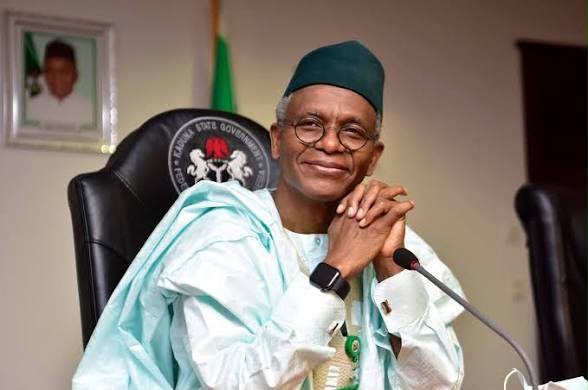
• Directs Justice Khobo to determine case in accordance with law and fairness Alex Enumah in Abuja The Chief Judge (CJ) of Kaduna State, Justice Muhammad Tukur Aliyu, has declined to transfer the criminal case against former governor, Mallam Nasir el-Rufai to another judge for fresh trial. The Chief predicated his refusal on the grounds that there is no basis to take away the case file from Justice Darius Hyet Khobo of the Kaduna State High Court, before whom the former governor is standing trial. Justice Aliyu, in an internal letter dated August 19 and sighted by Thisday, subsequently ordered the trial judge to proceed with the trial and determine it in line with the law and with fairness. el-Rufai is standing trial on a nine-count amended charge dated 10 April 2026, bordering on alleged advance-fee-fraud and corrupt-practices offences. Although he pleaded not guilty but has remain in custody of the Independent Corrupt Practices and other related offences Commission (ICPC), since his arrest and the subsequent refusal of his bail applications, by Justice Khobo. The refusal of Justice Khobo to grant him bail, pending the determination of the case, however prompted his petitions to the CJ, citing alleged bias and predetermination to convict the defendant. While the first petition was written on June 30, by el-Rufai’s team of lawyers led by Ubong Akpan, the former governor and a chieftain of the African Democratic Congress (ADC), personally wrote the second dated July 6. However, after due consideration of the petitions the CJ stated that he found no reason to invoke his administration powers to transfer the case to another judge. “I have studied and considered the petitions dated June 30, 2026 and July 6, 2026, respectively submitted by Counsel for the Defendant and the Defendant, as well as Your Lordship’s responses to the said petitions dated July 16, 2026. “Pursuant to the powers conferred on me under Section 111(1}+{4) of the Kaduna State Administration of Criminal Justice Law, 2017, a body of three (3) reputable legal! practitioners was constituted to investigate the petitions and submit its report. The committee submitted its report yesterday, August 18, 2026. “The Committee found no basis for the exercise of my administrative powers to transfer the matter from Your Lordship to another Judge of the High Court of Justice, Kaduna State. “Accordingly, Your Lordship shall proceed with the hearing and determination of the matter in accordance with the law and fairness”, the letter addressed to Justice Khobo read in part. The former had on July 6, personally wrote the CJ requesting the transfer of charge NO. KDOH/KAD/ICPC/01/2026 — Federal Republic of Nigeria v. Mallam Nasir el-Rufai – from Justice Darius Hyet Khobo to any other Judge of the High Court of Justice, Kaduna State. “I, Nasir Ahmad E!-Rufai, write this letter personally and in my own hand, on my own instruction and without the interposition of any intermediary, to bring to Your Lordship’s attention matters of the gravest constitutional and institutional magnitude concerning the conduct of Hon. Justice Darius Hyet Khobo in the charge pending against me before this Honourable Court. “I write with the full knowledge that this letter may form part of the record in proceedings before this Court, before the Court of Appeal, and before the National Judicial Council, as circumstances may dictate, and I write accordingly with all sense of responsibility. Your Lordship will forgive the directness of my language. “I have spent nearly three decades of my lifetime in public service. I care deeply about institutional integrity not only in Kaduna State but our nation at large. “I therefore know the difference between a judge who applies the law and a judge who has already decided the case”, el-Rufai stated. He claimed among others that Justice Khobo has already convicted him on the face of his ruling, when the judge held that el-Rufai’s “conduct during the failed attempt by the SSS to unlawfully arrest me and seize my passport, upon my voluntary return to Nigeria to respond to an EFFC invitation discloses not assertion of rights and resisting illegality but “a clear pattern of disregard for the rule of law”. “My Lord Chief Judge, this is not a bail-stage assessment of flight risk. This is a Character conviction. It brands me a lawbreaker before any evidence has been led, before any witness has testified, before the Prosecution has proved a single element of the nine-count charge beyond reasonable doubt. It is a finding on my character and criminal propensity that Section 36(5) of the Constitution reserves exclusively for the trial itself. “Second, the learned trial Judge recorded, as established fact rather than as an untested allegati
Don't miss out on breaking stories and in-depth articles.