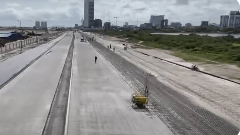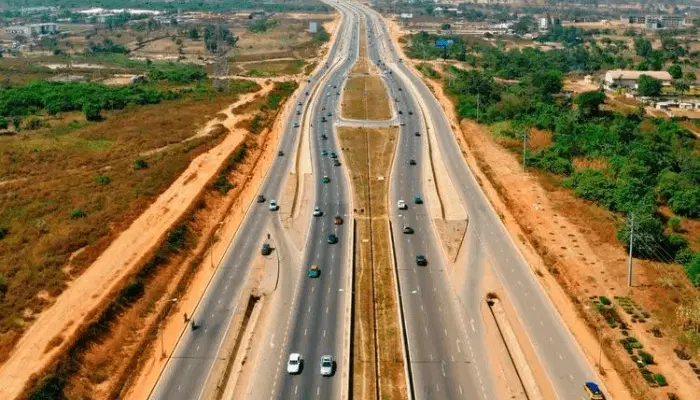
Iwere Engineers Forum, IEF, has urged President Bola Tinubu to immediately intervene in the reported plan to divert some sections of the Lagos-Calabar Coastal Highway away from the Atlantic coastline as the route approaches major Ilaje communities and the Itsekiri coastal belt. IEF said the engineering concerns cited by the Ministry of Works in the Ondo and Delta corridors, including deep peat, weak soils and large water crossings, were not sufficient justification for abandoning the areas. In a statement, the forum’s Chairman of the Board of Trustees, Professor Ogbemi Omatete; Vice Chairman, Gbesimi Akperi; General Secretary, Dr Silver Ejejigbe; and members Kunu Harmony, Dr Felix U. Atakere and Jude Pemu, said modern engineering offered multiple solutions, including corridor optimisation, strategic setbacks from the active shoreline, pile-supported embankments, viaducts, long-span bridges, staged consolidation, vertical drains, lightweight fills, deep foundations, advanced geotechnical monitoring and climate-resilient drainage. They urged the President to direct an immediate, independent comparative review of the Ondo-Delta alignment and make relevant alignment drawings, chainages, geotechnical assessments, bridge assumptions and comparative life-cycle cost evidence available to affected stakeholders, subject to legitimate security and procurement restrictions. They also called for the establishment of a joint technical working group involving the Federal Ministry of Works, relevant environmental and maritime agencies, the Ondo and Delta state governments, qualified independent engineers, including IEF, and representatives of affected coastal communities. The statement reads: “Our position is straightforward: a national project conceived, named and justified as a Coastal Highway should, subject to sound engineering and environmental safeguards, remain functionally coastal. It should run broadly parallel to the Atlantic coastline and directly unlock the coastal settlements, ports, jetties, fisheries, industrial locations and blue-economy assets for which such a corridor is uniquely valuable. Inland cities and state capitals can and should be connected to the trunk coastal corridor by high-quality strategic spurs and interchanges. The trunk road itself should not have to abandon the coastal development belt merely to provide access that can be achieved through connectors. “We acknowledge that the Federal Ministry of Works has publicly cited serious engineering concerns in the Ondo and Delta corridors, including deep peat, weak soils and large water crossings. IEF does not dismiss those concerns. Our concern is that they should not become reasons to abandon the coastal development objective before a transparent, independently verifiable comparison of viable set-back and hybrid coastal alignments has been completed. Modern engineering provides multiple responses: corridor optimisation, strategic setbacks from the active shoreline, pile-supported embankments, viaducts, long-span bridges, staged consolidation, vertical drains, lightweight fills, deep foundations, advanced geotechnical monitoring and climate-resilient drainage. “The appropriate engineering question is therefore not whether the road must sit on the beach. It should not. The question is whether a resilient Atlantic-facing corridor, generally set back from the active shoreline and locally adjusted around exceptional geotechnical, ecological and navigational constraints, can maintain direct access to the Ilaje and Itsekiri coastal belt. We submit that this alternative deserves full feasibility-level investigation before the coastal corridor is foreclosed. “The coastal road idea in this axis has deep historical roots. Public historical accounts of the late Chief Festus Okotie-Eboh record the planning of the Koko-Ogheye motor road, while later accounts describe the Koko-Ogheye-Epe concept as a coastal connection intended to shorten travel between Lagos and the Niger Delta. The Koko port facilities, Escravos navigation and other maritime infrastructure formed part of the same broader development vision. We therefore respectfully urge that today’s Lagos-Calabar project preserve, rather than bypass, the strategic maritime logic of connecting the Atlantic economic belt. “Coastal and deltaic highways are difficult infrastructure projects, but they are not unprecedented. Louisiana’s Department of Transportation and Development, for example, is replacing a vulnerable portion of LA 1 through sensitive coastal wetlands with an approximately 18-mile elevated highway because the existing route is affected by subsidence, erosion and flooding. The lesson is not that Nigeria should copy another country blindly; it is that modern highway engineering can maintain critical coastal access through weak wetland environments where the strategic case justifies the investment. Nige
Don't miss out on breaking stories and in-depth articles.