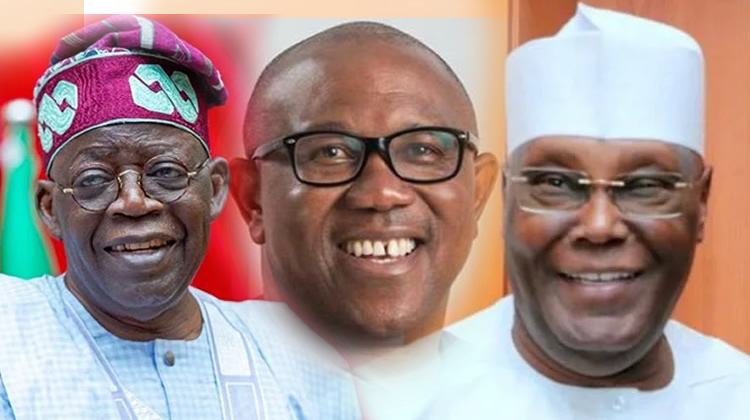
Olawale Olaleye With 13 weeks and three days to the January 16, 2027 presidential election, candidate of the Africa Democratic Congress (ADC), Alhaji Atiku Abubakar, has intensified his policy exchanges with the administration of President Bola Tinubu, particularly on petrol pricing, fiscal accountability and the cost of living.This gradually evolving debate, and the Presidency’s sometimes elaborate responses, have begun to change the character of the campaign conversation as the nation counts down to the election next January. Curiously, however, the presidential standard beaer of the National Democratic Congress (NDC), Mr. Peter Obi, appears to be missing in the emerging debate, albeit not totally in the wider conversation. Beyond the customary political intrigues, partisan recriminations, alliances and campaign rhetoric, an increasingly substantive argument about the direction of the country’s economy is beginning to take shape with the duo constantly sparring. The recurring disagreement between APC’s Bola Ahmed Tinubu and ADC’s Atiku Abubakar, is neither new nor particularly surprising.What is noteworthy, however, is the increasing specificity of the questions and policy alternatives being advanced by Atiku, and the detailed responses these have elicited from the Presidency. And, coming from Tinubu, who is naturally not disposed to a debate as evident during the 2023 presidential election, Atiku might have subtly forced the president and his government into interesting policy debate, and inadvertently changing the tenor of campaigns, based on issues.From the removal of petrol subsidy to the management of the exchange rate, public borrowing, taxation, government expenditure and the affordability of basic necessities, Atiku has repeatedly challenged the administration to explain not merely why its economic reforms were necessary, but how their benefits are reaching ordinary Nigerians. In doing so, the former vice-president has sought to shift the political conversation from personalities and partisan loyalties to the actual consequences of public policy. The government, on its part, has not allowed the arguments to go unanswered. Its statements, campaign interventions and direct responses have defended the logic of Tinubu’s reforms, challenged the financial sustainability of Atiku’s alternatives and questioned whether his proposals are compatible with existing legislation. This exchange has produced an interesting feature of the emerging presidential contest: a government defending the economic decisions it has already taken and an opposition candidate being pressed to explain the practical implications of the decisions he proposes to take.Yet, amid this increasingly sustained encounter, another major presidential candidate, Peter Obi of the NDC, has not occupied the same place in the particular exchange between Atiku and the Presidency. Obi has certainly not been silent on national issues. He has articulated positions on economic production, petroleum subsidy, corruption, electricity and public accountability. Indeed, his party recently criticised the government’s petrol discount. The distinction is that the recent sequence of proposals, presidential responses, counterproposals and fiscal arguments has developed principally around Atiku’s intervention. That development offers a useful window into the changing character of the 2027 contest. From Political Rhetoric to Policy Alternatives For much of Nigeria’s Fourth Republic, presidential campaigns have frequently been shaped by questions of ethnicity, religion, zoning, personalities and political alignments. Although economic policy has never been entirely absent, the technical details of proposed reforms have not always received the sustained public interrogation that a country facing serious structural economic challenges requires. The present circumstances make such an interrogation particularly relevant. When President Tinubu assumed office on May 29, 2023, he announced the removal of petrol subsidy, setting in motion one of the most consequential economic decisions of his administration. Changes in the foreign exchange system followed, while the government subsequently introduced far-reaching tax and fiscal reforms.The administration has maintained that these decisions were necessary to correct distortions, improve government finances, encourage investment and place Nigeria on a more sustainable economic footing. Atiku’s central objection is solely about the implementation of those reforms, the social protection available to vulnerable citizens and the accountability mechanisms governing the resources released. The argument became particularly pronounced in August 2026, when the ADC presidential candidate publicly pledged to restore petrol subsidy if elected.His declaration attracted immediate criticism, partly because
Don't miss out on breaking stories and in-depth articles.