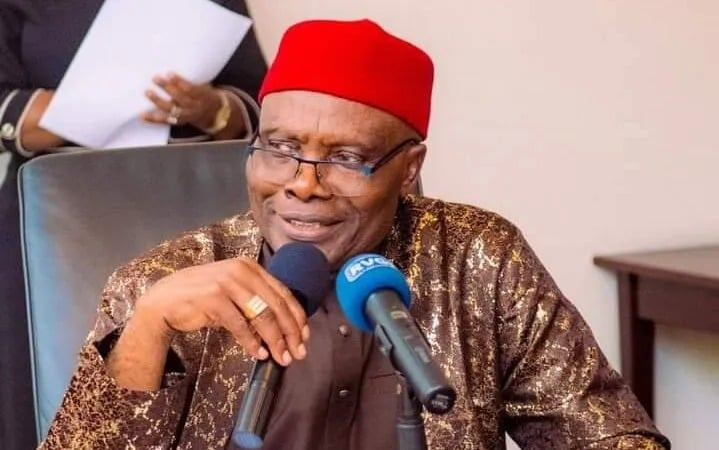
By Malachy Agbo From technology-driven surveillance and rapid-response operations to forest security and intelligence-led policing, the governor of Enugu State, Dr. Peter Ndubuisi Mbah-led administration has made security one of the central pillars of its development agenda. As the 2027 elections approach, the challenge is to protect these gains, establish the facts behind emerging controversies, and ensure that political competition does not come at the expense of public safety. The former Governor of Ogun State, Chief Aremu Olusegun Osoba, offered an illuminating account of the security situation in Enugu State when he addressed participants at the recently concluded Nigeria Guild of Editors Conference in Enugu. He recounted how he had assured his wife that those responsible for abducting a Catholic seminarian and other worshippers at a church in Affa, Udi Local Government Area, would be apprehended. According to his account, he was subsequently pleased to learn that the suspects had been arrested. The significance of that account goes beyond the apprehension of suspects. It highlights the importance of a security system capable of gathering intelligence, mobilising personnel, pursuing criminal networks and bringing suspected perpetrators before the law. It also underscores a fundamental responsibility of government: to ensure that criminal elements cannot operate with impunity or dictate the terms on which citizens live, worship, work and conduct their businesses. The Affa incident was undoubtedly distressing. On August 2, 2026, gunmen abducted three people, including a seminarian, during a church service at St. Joseph Catholic Church in Inoyi, Affa community. Subsequent reports by the police and other media organisations documented arrests linked to the incident, the recovery of firearms and the eventual release of the remaining victims. These developments demonstrate the importance of coordinated security operations, although the initial attack also serves as a reminder that the threat of kidnapping has not been completely eliminated. For Governor Peter Ndubuisi Mbah, the incident reinforces a principle that has defined his administration since its inception: security is not an optional component of governance – it is the foundation upon which economic growth, infrastructure development, education, healthcare, tourism and public confidence must rest. When Mbah assumed office in May 2023, the South-East was grappling with the disruptive effects of the Monday sit-at-home order imposed by non-state actors. Enugu, as a major commercial and administrative centre in the region, experienced the economic and social consequences of restrictions that discouraged traders from opening their shops, workers from reporting to their workplaces, children from going to school and residents from moving freely. Beyond the direct economic losses, the climate of fear affected transport operators, small-business owners, students, civil servants and families whose daily routines depended on the freedom to move around without intimidation. The sit-at-home phenomenon also imposed less visible costs. Business owners faced uncertainty, workers lost productive hours, and investors had to consider whether their operations could function reliably in an environment where movement might be disrupted at very short notice. The most ignoble aspect of it is that most of the disruptive orders came from faceless voice notes. The Mbah administration moved to end the compulsory Monday sit-at-home and other similar orders in Enugu State and restore normal economic activity. The policy direction was clear: no individual or group outside the constitutional order should possess the power to determine whether lawful businesses open or whether citizens can go about their legitimate activities. This was not merely a question of reopening shops on Mondays. It was a question of restoring public authority, protecting livelihoods and defending the right of citizens to participate in economic and social life without coercion. The administration also pursued measures aimed at removing unauthorised barricades and improving movement across the state, alongside efforts to strengthen security coordination and reduce the disruptions associated with excessive or poorly coordinated checkpoints. These measures must ultimately be assessed by their practical effects: whether commuters can travel safely, traders can operate consistently, workers can reach their destinations and families can go about their daily lives without undue fear. The objective should remain clear and measurable: public spaces must belong to the people, not to criminal groups or individuals seeking to impose their will through violence. One of the most significant aspects of the Mbah administration’s security strategy is its emphasis on technology, surveillance, rapid response and inter-agency coo
Don't miss out on breaking stories and in-depth articles.